
 United States
North American manufacturing is in a multi-year expansion led by capital spending on automation, electrification and industrial infrastructure.
The reshoring and nearshoring trends, combined with supportive tax policy, are providing stronger revenue visibility and lowering after-tax financing costs for issuers that manufacture capital goods.
We believe this supports the tightening of spreads within the diversified capital goods sector as end-market demand pivots from global to regional project pipelines.
A long runway of construction-driver orders
US manufacturing construction outlays reached record highs in 2024 and, at more than US$200bn a month, remain at almost triple pre-pandemic levels.1
Planning starts are also highly elevated after having peaked in 2022, when the Inflation Reduction Act and CHIPS Act were both signed into law. While projects may be delayed or abandoned, planning starts are a useful leading indicator of construction starts which, in turn, precipitate construction spending.
These two metrics point towards a durable capital expenditure (capex) cycle, rather than a one-off spike – despite the backdrop of elevated US interest rates.2
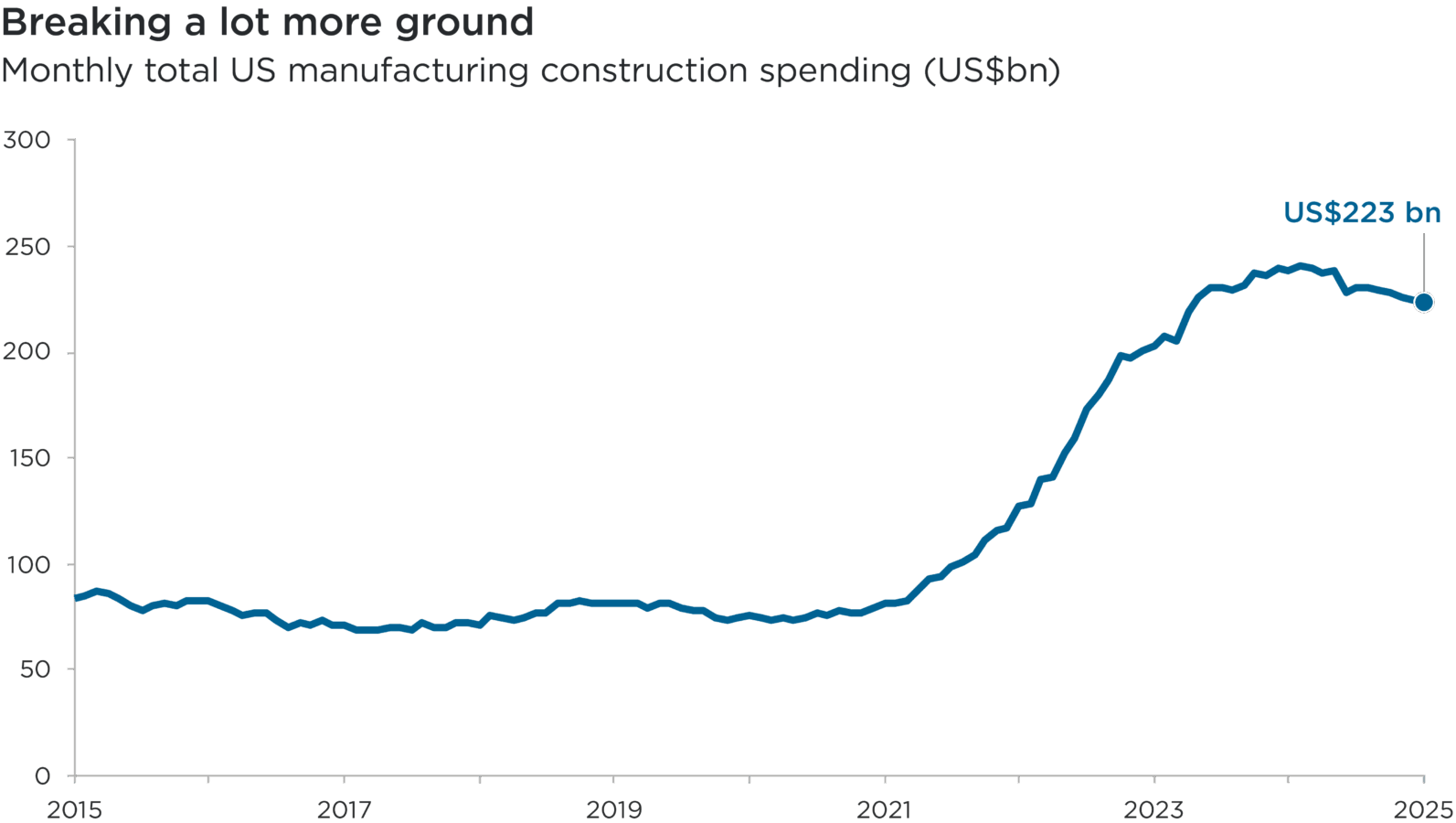
Source: Federal Reserve Bank of St. Louis, July 2025
Subhead: Monthly total US manufacturing construction spending (US$bn)
Overview: This line chart shows the value of US manufacturing construction spending, by month, from July 2015 to July 2025.
Overall, this chart illustrates how US manufacturing construction spending remained relatively flat until late 2021. Having then risen sharply, spending peaked in 2024 and remains at historically elevated levels.
Orders driven by manufacturing construction typically flow first into power infrastructure – including switchgear, transformers and cables – and later into systems such as controls, sensors and industrial heating, ventilation and air conditioning (HVAC) as facilities near commissioning.
Capital goods issuers that derive most of their revenues from North America – and are subsequently most exposed to the US factory infrastructure boom – should be expected to enjoy enhanced revenue visibility as orders are converted into revenues over the coming years.
Trade and tax policies support domestic capex plays
The reshoring of manufacturing has become an explicit objective of trade policy under the Trump administration. Import tariffs narrow the cost gap for domestic production, reinforcing the economic rationale for onshoring and supporting sustained demand for factory electrification, automation and environmental controls.
While it is too early to draw conclusions on the efficacy of tariffs in this regard, the scale of the US trade deficit highlights the significant spending that could potentially shift from overseas to domestic manufacturers. In 2024, the US trade deficit in capital goods totalled roughly US$320bn.3
US capital goods manufacturers are already benefiting from tighter integration of supply chains across the US-Mexico border. Mexico overtook China as the leading source of US goods imports in 2023, due largely to corporate nearshoring strategies.4
Shorter lead times and easier cross-border commissioning favours regional vendors, so integration of supply chains converts into more orders on both sides of the border. Rules of origin under the USMCA free trade agreement between the US, Mexico and Canada continue to benefit US capital goods manufacturers, which typically supply higher-value components. Provisions requiring compliance with North American standards further support demand for US suppliers of critical parts. In addition, a growing installed base on both sides of the border also contributes to more recurring, higher-margin revenues from services and software.
Recent fiscal policy changes, meanwhile, reduce cash taxes and effectively lower after-tax financing costs for capital-intensive US manufacturers.
The One Big Beautiful Bill Act, enacted in July 2025, permanently restored 100% bonus depreciation, introduced a new elective 100% depreciation allowance for qualifying manufacturing plants in the US, and made permanent more generous business interest expense limitations.5 It also reinstated immediate expensing of domestic research and experimentation expenditures. Together, these changes will enable faster cost recovery and higher deductible interest, thereby reducing effective tax burdens and improving free cash flow for US capital goods manufacturers.
What we believe markets are not pricing in
Onshoring and nearshoring are redirecting global capex towards North America.6 Elevated US factory construction, in addition to trade and tax policy tailwinds, create a favourable backdrop for diversified capital goods issuers tied to factory electrification, grid-adjacent gear, automation and controls, and industrial HVAC systems.
But bond markets do not appear to have priced in the winners from the North American manufacturing buildout. We believe the tight benchmark masks issuer-level mispricing. The capital goods issuers most exposed to this trend still show little or no premium to less exposed peers (see chart below).
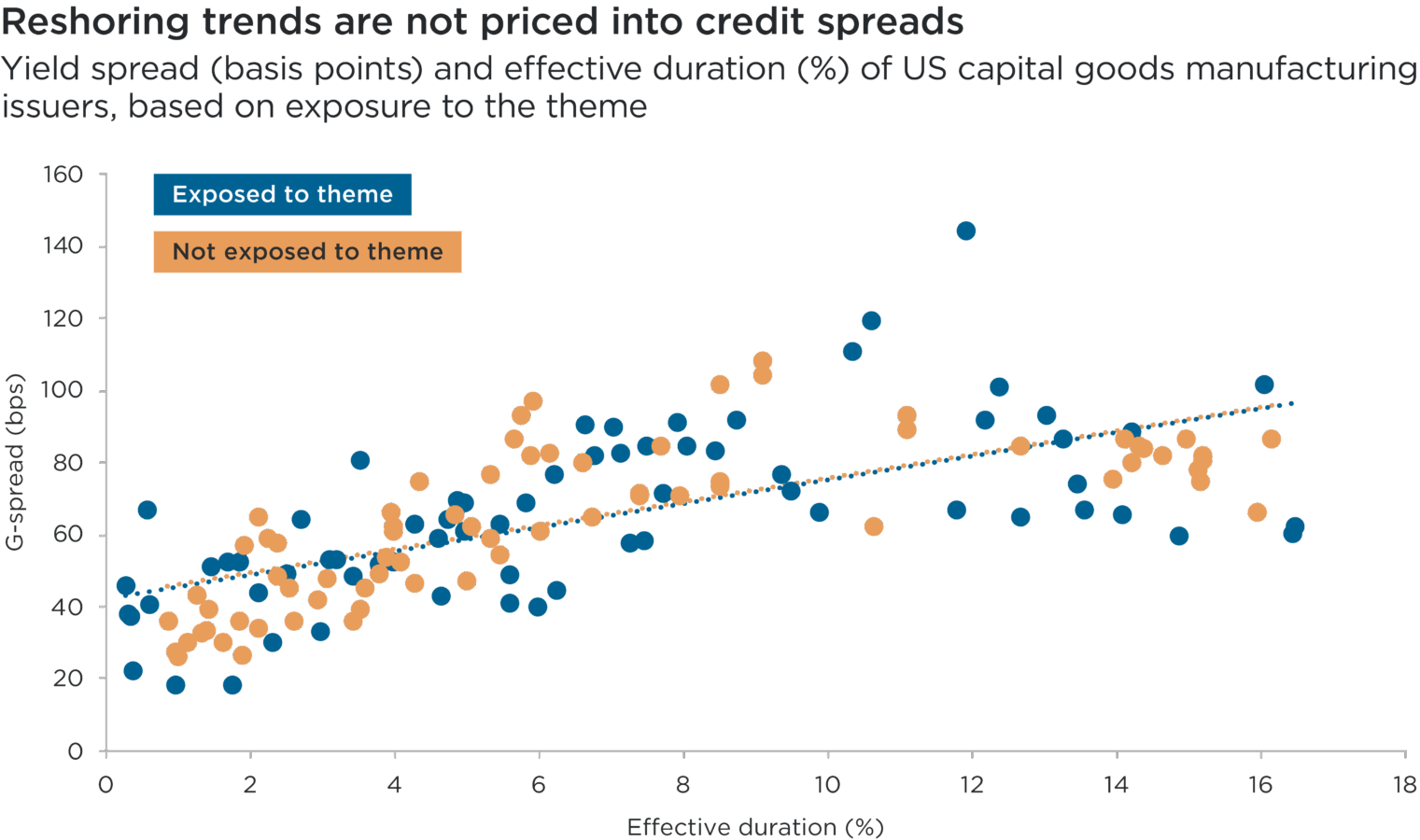
Source: Impax analysis of Bloomberg data, October 2025. G-spread is the difference in yield between a corporate bond and a US government bond of similar maturity. Exposure and non-exposure to the reshoring theme is defined by Impax. Credits were assigned into groups based on US exposure, manufacturing product output and end-market exposure. Data was normalised for credit rating and issuance duration.
Subhead: Yield spread (basis points) and effective duration (%) of US capital goods manufacturing issuers, based on exposure to the theme
Overview: This scatter chart plots the G-spread and effective duration of US capital goods manufacturing issuers, based on whether or not they are judged by Impax to be exposed to the reshoring theme.
Overall, this chart illustrates that there is no material correlation between issuers’ exposure to this trend and yield spreads on their issuances.
As these dynamics play out, we see potential for a repricing of bonds issued by capital goods manufacturers with strong North American exposure, and we expect spreads to narrow relative to their more globally-focused peers.
The degree of potential repricing will depend on the durability of industrial construction demand, the momentum of onshoring and nearshoring trends, and the execution of recent US tax policies.
We continue to monitor all of these factors, while also tracking input price pass through and project timing. In this context, we prefer issuers that can contractually pass on cost increases and source materials locally to protect margins, as well as issuers with diverse customer bases and strong service offerings to reduce the impact of project delays.
1 Federal Reserve Bank of St. Louis, July 2025: Total Construction Spending: Manufacturing in the United States
2 Brandsaas, E. E., Kurtzman, R., & Nichols, J., January 2025: From plans to starts: Examining recent trends in manufacturing plant construction. FEDS Notes
3 U.S. Census Bureau, & U.S. Bureau of Economic Analysis, February 2025: U.S. international trade in goods and services, December 2024
4 U.S. Census Bureau, & U.S. Bureau of Economic Analysis, February 2025: U.S. international trade in goods and services, December 2024
5 U.S. Congress, July 2025: One Big Beautiful Bill Act
6 Tett, G., 10 October 2025: America is sucking in growth from the rest of the world. Financial Times
Nothing presented herein is intended to constitute investment advice and no investment decision should be made solely based on this information. Nothing presented should be construed as a recommendation to purchase or sell a particular type of security or follow any investment technique or strategy. Information presented herein reflects Impax Asset Management’s views at a particular time. Such views are subject to change at any point, and Impax Asset Management shall not be obligated to provide any notice. Forward-looking statements or forecasts herein are subject to known and unknown risks and uncertainties including inaccurate assumptions that could cause actual results to differ materially from those expected or implied by the forward-looking statements. . While Impax Asset Management has made reasonable efforts to obtain information from reliable sources, we make no representations or warranties as to the accuracy, reliability or completeness of third-party information presented herein. No guarantee of investment performance is being provided and no inference to the contrary should be made.