
 United States
The Federal Reserve (the Fed) raised rates 25 basis points to 3.75% – 4.00% in September, its first hike in over three years, and signaled one more.1 We were watching the Fed’s credibility more than the rate, and the unanimous vote reassured us on both. Markets agreed: rates barely moved and credit flinched.
Where we part from the consensus is on what comes next. We think the market has read Chair Warsh too hawkishly. The expansion the Fed described – solid activity, resilient spending, strong productivity – is the supply-side, productivity-led kind that historically cools inflation rather than stoking it.
From here, we feel the real risk is energy, not the Fed. Rates are now largely a derivative of oil, which makes geopolitical de-escalation the variable we will watch most closely. That is a market where we would rather own high-quality income than take a view on rates.
Here are five ways our Impax Core Bond Fund may complement a client’s diversified portfolio now that the decision is in.
1. Investment-grade starting yields are among the highest in nearly two decades.
Before the meeting, the 10-year US Treasury briefly topped 5% for the first time in almost three years, its highest level since 2007, before easing to around 4.93%.2 That is seven straight months of rising yields, painful for anyone who held bonds on the way up.
But for money being invested today it can mean income levels unseen since before the financial crisis, at high credit quality with daily liquidity.
Bloomberg US Aggregate Yield to Worst (YTW)
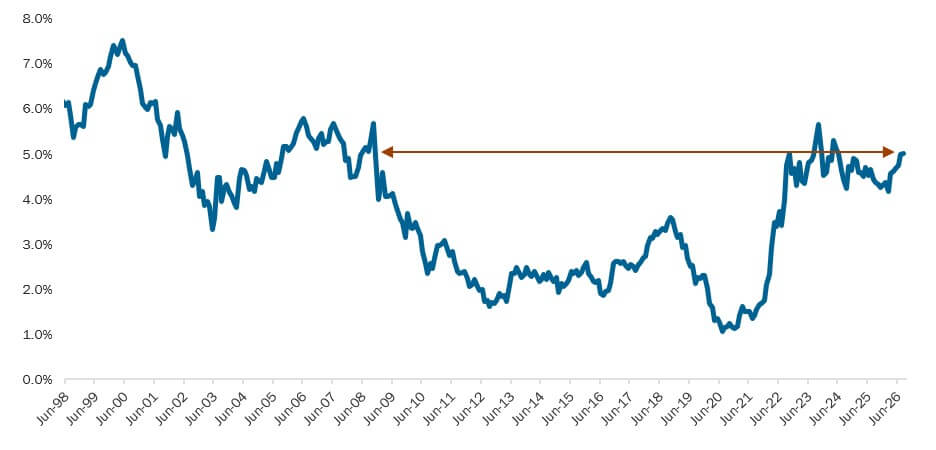
Source: Bloomberg, as of 31 August 2026. For illustrative purposes only: no assurances that the trends shown here will continue in the future.
2. When the rate path is uncertain, a fund that can add value from credit rather than rate calls may help.
The Fed hiked and signaled one more rate hike was forthcoming, yet the median consensus indicated no further hikes were anticipated in 2027 and inflation is not expected to return to 2% levels until 2029, so the Fed’s medium-term pathways remain uncertain.3
Rather than try to profit from that path, the Impax Core Bond Fund leans on credit. It runs an overweight to credit and a large structured and securitized allocation skewed to shorter-duration cash flows, while keeping overall duration broadly neutral.
Duration is not a primary source of alpha, and the Fund does not position for the direction of rates. The credit tilt has helped through the selloff, with the structured book holding up on down days, because the aim is sector and security selection, not a rate call.
3. A core allocation can provide ballast.
In a market like this, a core allocation is often considered the anchor that lets an investor stay the course while everything else moves. This Impax Core Bond Fund is a true core holding built as a ballast against equity risk, not a theme or a duration bet.
The entry point helps: at the Bloomberg US Aggregate Index’s recent yield to worst, an investment today would only start to lose value over the next year if that yield climbed toward roughly 6.2%, and the index has not carried a yield to worst above 6% since 2001.4
For an investor rattled by a 5% 10-year, the Fund offers a high-quality portfolio that can do its job when it is needed most.
Bloomberg US Aggregate Yield to Worst (YTW) vs 5-year forward return
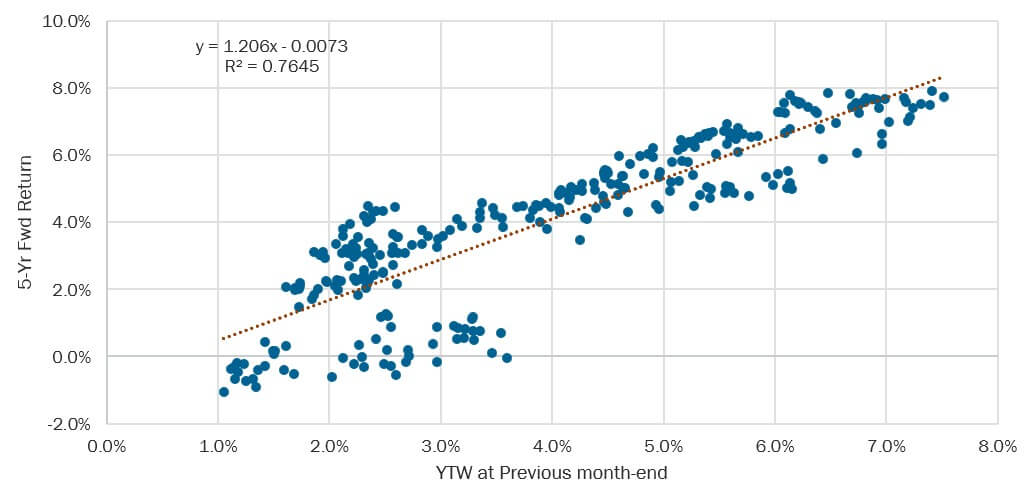
Note: Using month-end values YTW values. Source: Bloomberg, as of 31 August 2026. For illustrative purposes only: no assurances that the trends shown here will continue in the future. The regression equation illustrated here is not intended for prediction and investment purposes. Further information is available upon request.
4. When issuance is heavy, active managers can be selective.
Too much investment grade supply can do as much damage as inflation. A swelling federal deficit, record corporate issuance, and AI-related borrowing are all weighing on the long end, even with Treasury buying back longer-dated debt to ease the pressure.
However, the money keeps coming. US bond mutual funds and ETFs drew about $625bn this year through August, the most for that stretch in Morningstar data going back to 2010.5 Much of that lands in index funds, which buy the index weights whether or not a deal is priced well and hold deteriorating credits because the index says so. As active managers, we don’t have to. We can lean into new-issue concessions, rotate toward value, and walk away from credits we don’t want.
Recently we did not invest in a large financial issuer that offered no new-issue concession, captured an outsized concession on a mega-cap technology deal, and took an inaugural issue with change-of-control protection. We’ve rotated from lower-coupon into higher-coupon corporates and trimmed duration where we take credit risk. In a market absorbing this much supply, the ability to choose is increasingly important.
5. When markets turn volatile, a track record of dampening that volatility is what counts.
The Impax Core Bond Fund has run a lower standard deviation than the Bloomberg US Aggregate Bond Index benchmark over the 1-, 3-, and 5-year and since-inception periods.6 It carries below-average risk in its Intermediary Core Bond Morningstar category7 and ranked in the 44th percentile out of 382 funds in the category over 5 years based on total returns, as of August 31, 2026.8
Performance data quoted represent past performance, which does not guarantee future results. Investment return and principal value of an investment will fluctuate so that an investor’s shares, when redeemed, may be worth more or less than their original cost. Current performance may be lower or higher than the performance data quoted. For most recent month-end performance information, visit www.impaxam.com.
In a market where the 10-year has recently breached 5% and volatility is elevated, that risk profile is exactly why now may be the moment to talk to your clients and prospects.
The test of a core fund is not the easy years but the hard ones, which may be the environment we are entering.
Learn more about the Impax Core Bond Fund or contact your Intermediary Sales Contact for more information.
- Reuters, “Fed policymakers forecast one more rate hike this year.” reuters.com/business/fed-forecasts-see-latest-hike-followed-by-another-before-end-year-2026-09-16 ↩︎
- CNBC, US 10 Year Treasury, cnbc.com/quotes/US10Y ↩︎
- Federal Open Market Committee, September 16, 2026: FOMC Projections materials, accessible version, federalreserve.gov/monetarypolicy/fomcprojtabl20260916.htm ↩︎
- Breakeven is an approximation. Over a one-year horizon, a bond index’s total return is roughly its starting yield to worst less the product of its duration and the change in yield. Setting that to zero, the yield rise that offsets one year of income is approximately yield to worst divided by duration. For the Bloomberg US Aggregate Index, 5.32% ÷ 5.85 = 0.91%, giving a breakeven yield level of approximately 6.2%. ↩︎
- Source: Morningstar ↩︎
- As of August 31, 2026, the Annualized Standard Deviation of the Impax Core Bond Fund – Institutional Class was: 1-year: 3.0%, 3-year: 5.4%, 5-year: 6.1%, and since first full month following inception (January 2017): 4.9%. For the same time periods, the Bloomberg Barclays US Agg. Bond Index (Total Return) Annualized Standard Deviation was: 1-year: 3.1%, 3-year: 5.5%, 5-year: 6.3%, and since January 2017: 5.1%. ↩︎
- Morningstar Risk is an assessment of the variations in an investment’s monthly returns in comparison to similar investments. The greater the variation, the larger the risk score. The Impax Core Bond Fund – Institutional Class has a 5-year Morningstar Portfolio Risk Score (MPRS) of 15, Risk Level: Conservative. MPRS measures the overall risk of a managed investment’s portfolio. MPRS uses Morningstar Risk Model’s holdings-based analysis to derive a risk estimate and score, and Morningstar’s multi-asset Target Allocation Indexes to define the risk ranges. Morningstar Portfolio Risk Score Methodology: morningstar.com/research/signature ↩︎
- As of August 31, 2026, the Impax Core Bond Fund – Institutional Class Morningstar Rankings were: 1-year: 45th percentile (out of 451 Funds), 3-year: 65th percentile (out of 418 Funds), and 5-year: 44th percentile (out of 382 Funds). Morningstar’s percentile ranking is based on the highest (or most favorable) percentile rank of 1 and the lowest (or least favorable) percentile rank of 100. Past performance is no guarantee of future results.
↩︎
Definitions
A basis point (bp) is used to indicate changes in the interest rates of a financial instrument. One basis point is equal to 1/100th of 1%, or 0.01%
Duration is a measure of a security’s price sensitivity to changes in interest rates. Securities with longer durations are more sensitive to changes in interest rates than securities of shorter durations.
Cash flows are the principal and interest payments an investor expects to receive from a bond or other fixed income investment. Shorter-duration cash flows are cash receipts that arrive relatively soon—such as near-term bond coupons and principal repayments, or CDs maturing within months. In fixed income, duration also measures both the cash-flow-weighted time needed to recover an investment and a bond’s sensitivity to rate moves: shorter-duration holdings typically experience smaller price swings when rates change.
Alpha is a coefficient measuring risk-adjusted performance, considering the risk due to the specific security, rather than the overall market. A positive alpha reflects relative risk-adjusted performance of the Fund versus its benchmark.
Bloomberg US Aggregate Bond Index is a broad based index, maintained by Bloomberg L.P. often used to represent investment grade bonds being traded in United States.
Yield to Worst (YTW) is a measure of the lowest possible yield that can be received on a bond with an early retirement provision.
Important Information:
Impax funds are distributed by Foreside Financial Services, LLC. Foreside Financial Services, LLC is not affiliated with Impax Asset Management LLC.
You should always consider Impax funds’ investment objectives, risks, and charges and expenses carefully before investing. For this and other important information, please obtain a fund prospectus by calling 800.767.1729 or visiting www.impaxam.com. Please read the prospectus carefully before investing.
Diversification cannot assure a profit or protect against loss in a down market.
Risks: Investments involve risk, including potential loss of principal. Yield and share price will vary with changes in interest rates and market conditions. Investors should note that if interest rates rise significantly from current levels, bond fund total returns will decline and may even turn negative in the short term. Mortgage related securities tend to become more sensitive to interest rate changes as interest rates rise, increasing their volatility. There is also a chance that some of the fund’s holdings may have their credit rating downgraded or may default. The Fund invests in companies that the Adviser believes are well positioned to benefit from the transition to a more sustainable global economy, integrating a proprietary corporate resilience analysis that considers governance structures, the management of material environmental and social risks, climate risks (physical and transition), human capital management, and controversies into portfolio construction and managing the portfolio within certain risk parameters (e.g., sector and regional exposure) relative to the Fund’s benchmark universe. The Fund is actively managed, and investment decisions based on Corporate Resilience factors may adversely impact the Fund’s performance.
The investment techniques and decisions of the investment adviser and the Fund’s portfolio manager(s), including the investment adviser’s assessment of a company’s Issuer Resilience profile when selecting investments for the Fund, may not produce the desired results and may adversely impact the Fund’s performance, including relative to other funds that do not consider Issuer Resilience factors or come to different conclusions regarding such factors
Impax is a trademark of Impax Asset Management Group Plc. Impax is a registered trademark in the UK, EU, US, Hong Kong, Canada, Japan and Australia. © Impax Asset Management LLC, Impax Asset Management Limited and/or Impax Asset Management Ireland Limited. All rights reserved.