
 United States
Patience is rarely seen as a virtue among equities investors these days. The cacophony of market noise is amplified by the 24/7 news cycle and social media, leading to a market zeitgeist which is more reactionary and volatile.
Hype might have replaced reason, but for how long can investors continue to obsess over narrow market verticals – and so misprice broader opportunities and risks – while powerful forces quietly transform the global economy?
It is our conviction that by correctly interpreting secular trends, and by taking a disciplined focus on stock valuations, we can exploit market inefficiencies that arise from investor myopia.
Understanding secular trends
The global economy is being reshaped by enduring and dynamic trends, including advancements in technology and evolving consumer preferences. It must also adapt to systemic risks like those posed by climate change and biodiversity loss.
As these dynamics unfold over the coming decades, accelerating the transition to a more sustainable economy, whole sectors will be redefined. Individual companies must adapt to evolving risks and opportunities through their strategy, products and services.
Take manufacturing, for example: improving technology and falling costs have led to rising automation of processes.1 Factory automation is creating many ‘winners’: from successful adopters – who optimise their operations – to the innovative companies behind industrial automation software (like US-listed Emerson Electric) and advanced sensors for robotics (like Japan-listed Keyence).
It is our conviction that having a deep understanding of structural changes underway in the global economy can help fundamental research-driven equities investors pursue better risk-adjusted outcomes. Secular trends do not always follow linear paths, though. Diligent investors who astutely interpret their cycles, and the opportunities and risks arising from them, clearly have potential to outperform the overall market over the longer term.
“Myopic markets commonly discount business models that are well-placed to capitalise on the secular themes reshaping global society”
Charles French
Short-termism misprices long-term value
Yet investors are often – and arguably increasingly – drawn into a short-term, reactionary mindset that neglects the significance of long-term shifts.
Relentless news flow, including quarterly company results and political rhetoric, can distract focus from where a business will be – and how different the economic backdrop will look – in five or ten years.
Transitory headwinds (and headlines) widely obscure the structural tailwinds that tee many business models up for long-term growth.
Myopic markets commonly discount business models that are well-placed to capitalise on the secular themes reshaping global society. Yet the time horizons of most equities investors – from individual savers to institutions managing pension scheme liabilities – align with those of the long-term trends, not the limited attention span of today’s news cycle.
By maintaining a perspective measured in years, and so staying alert to where short-term noise deviates from long-term fundamentals, strategically minded investors can identify and capitalise on market inefficiencies.
Solutions to mounting challenges
The environmental and social challenges posed by structural trends in global society – from finite natural resources to ageing populations – are creating what are, in our view, the most compelling long-term opportunities within equities markets today.
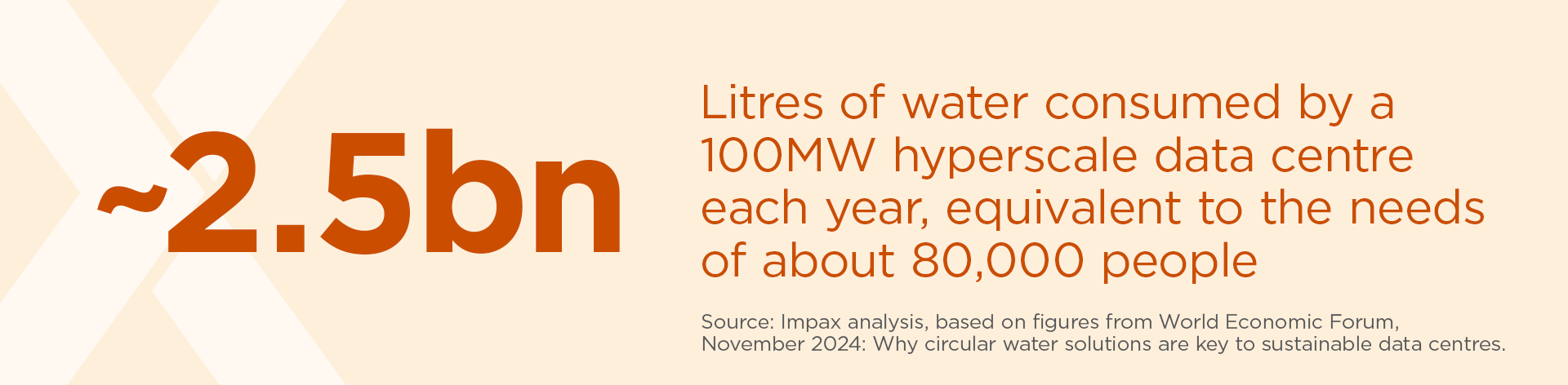
Consider the environmental challenges arising from the artificial intelligence (AI) boom, for example. Data centres accounted for 1.5% of global electricity consumption in 2024 – a share expected to double by 2030.2 Some estimates are higher, based on projections associated with the training of large-scale ‘frontier’ AI models. Servers’ cooling needs meanwhile mean that hyperscale data centres can directly use around 2.5bn litres of water each year.3
Managing costs and ensuring security of power and water supply is driving the adoption of resource-efficient solutions by data centre operators. Water-saving technologies like closed-loop liquid cooling systems, developed by Schneider Electric and Vertiv, are being installed by the likes of Microsoft.4 Investments to improve energy efficiency meanwhile support demand for increasingly customised semiconductors, designed by the likes of Marvell Technologies, and advanced power management solutions developed by companies including Monolithic Power Systems.
Equally pressing – and investable – are innovative solutions to rising social challenges like rapidly ageing populations. Demographics, combined with the rise of chronic health issues and labour shortages, are placing global healthcare systems under increasing strain.
Financial pressures support vast opportunities within the US$10tn global healthcare industry for medical technologies that can reduce the cost of healthcare delivery while improving patient outcomes. Paradigm-changing advances in robotics by the likes of Intuitive Surgical, for instance, are enabling quicker recoveries from minimally-invasive surgeries and so are shortening hospital stays (saving costs for insurers and healthcare systems).5
Identifying winners from transformations
Identifying the potential winners in the transition to a more sustainable economy takes patience, experience and specialist expertise.
At Impax, we aim to identify those innovative companies that are well-positioned to benefit and that can deliver compelling risk-adjusted returns for their shareholders. We do this through deep understanding of economic transformations, combined with our rigorous approach to fundamental analysis and macroeconomic and quantitative research.
At a time when many equities investors seem to be underappreciating these powerful secular trends, we take a longer-term approach. We believe that our disciplined perspective allows us to exploit market inefficiencies and better understand the mispricing across the full spectrum of this non-linear transition.
1 International Federation of Robotics, September 2025: World Robotics 2025 Report
2 IEA, April 2025: Energy and AI
3 World Economic Forum, November 2024: Why circular water solutions are key to sustainable data centres
4 Microsoft, December 2024: Sustainable by design: Next-generation datacenters consume zero water for cooling
5 Cleveland Clinic, 2024: Robotic Surgery
References to specific securities are for illustrative purposes only and should not be considered as a recommendation to buy or sell. Nothing presented herein is intended to constitute investment advice and no investment decision should be made solely based on this information. Nothing presented should be construed as a recommendation to purchase or sell a particular type of security or follow any investment technique or strategy. Information presented herein reflects Impax Asset Management’s views at a particular time. Such views are subject to change at any point and Impax Asset Management shall not be obligated to provide any notice. Any forward-looking statements or forecasts are based on assumptions and actual results are expected to vary. While Impax Asset Management has used reasonable efforts to obtain information from reliable sources, we make no representations or warranties as to the accuracy, reliability or completeness of third-party information presented herein. No guarantee of investment performance is being provided and no inference to the contrary should be made.