
 United States
For the second time in four years, Europe faces an energy crisis. The destruction of oil and gas infrastructure in the Gulf and the effective closure of the Strait of Hormuz raise the prospect elevated prices and supply disruption for months, if not years.
Predictably, the response from some commentators and policymakers is to call for expanded European oil and gas production, more nuclear generation and the easing of climate policies. These calls are misguided. Realistically, renewable generation is the fastest way to deliver affordable energy that is far less exposed to geopolitical disruption.
It is not as simple as adding renewables to grids, however. To keep the lights on, and balance intermittent supply and demand, significant investment in both short- and long-duration energy storage is needed. Decentralised generation can also play an important role.
For investors in the European renewables market, the pressing need for investment in more resilient energy systems supports opportunities to deploy capital.
Europe’s enduring energy insecurity
Europe imports three-quarters of its crude oil and more than half of its natural gas supplies.1 With liquified natural gas (LNG) now accounting for 45% of trade in the latter, both are globally-traded commodities whose prices are highly sensitive to shifts in supply and demand.2
In times of scarcity, prices can spike: global crude prices rose by roughly 50% in the month following the onset of the Iranian conflict; European gas prices meanwhile doubled (see chart below).3
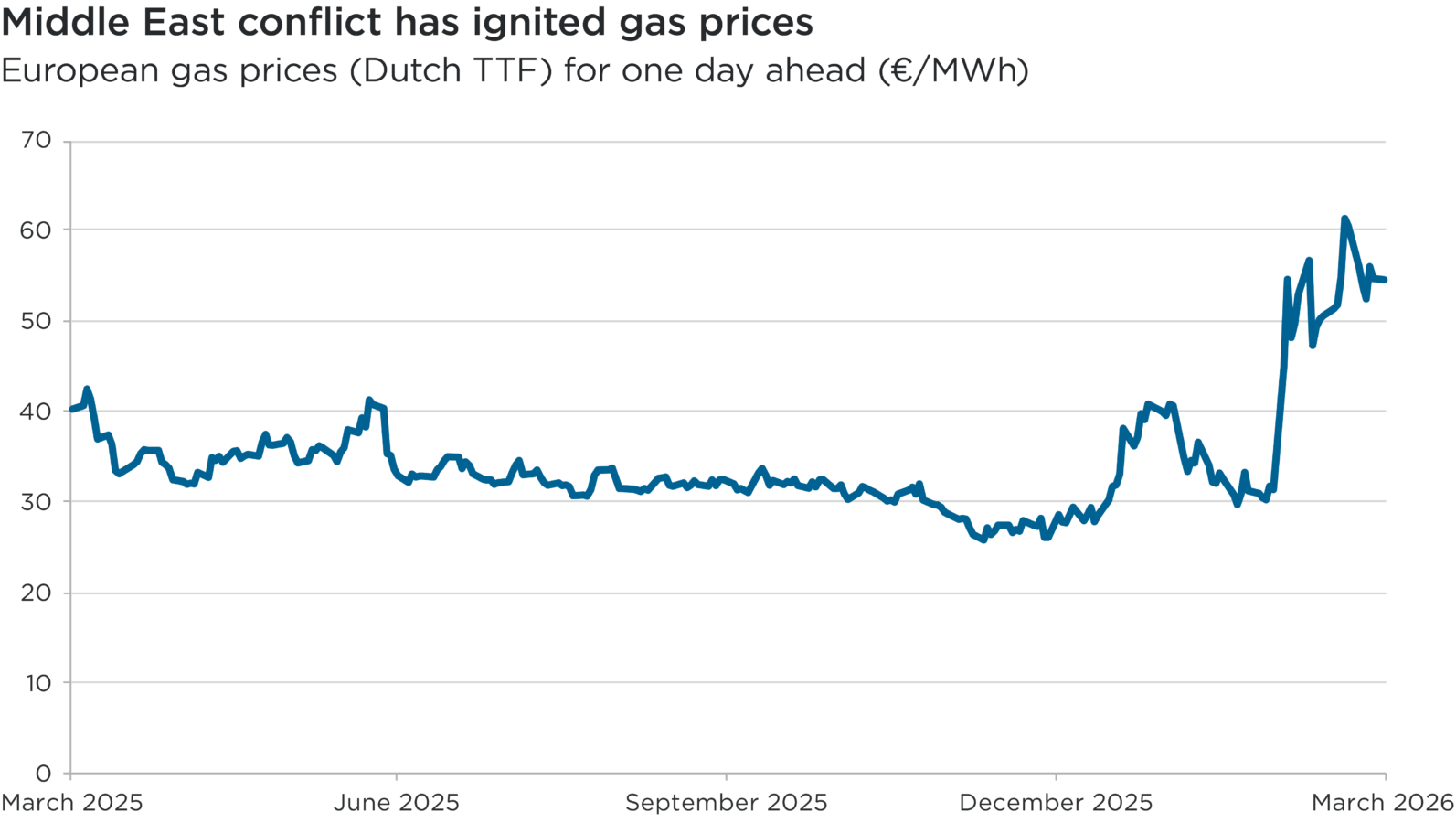
Source: Bloomberg, 30 March 2026
Subhead: European gas prices (Dutch TTF) for one day ahead (€/MWh)
Overview: This line chart shows European natural gas prices, as measured by Dutch TFF (Title Transfer Facility), for delivery one day ahead from the end of March 2025 to the end of March 2026.
Overall, this chart illustrates how European gas prices remained relatively stable until the onset of conflict in Iran, at the end of February 2026. Prices almost doubled in March 2026.
Although gas and oil’s shares of European primary energy have gradually declined since 2010, their prices continue to shape the competitiveness of industry and consumer bills.4
In economies where electricity prices are largely determined by the marginal cost of gas, elevated fossil fuel prices undermine competitiveness and feed through to consumer bills. For example in Italy, where gas determined electricity prices 89% of the time in early 2026 (see chart below), forward electricity prices for summer 2026 have spiked by more than four times as much as they have in France.5,6
In this context, ramping up domestic or regional oil and gas production seems attractive to some. Yet the potential to do so is limited given declining output from ageing fields and long development cycles. Indeed, the increase in energy prices following the last supply shock in 2022 proved insufficient to reverse the long-term decline in North Sea production.7
Even if permanently elevated energy prices made it economical to maximise production from new and existing projects, the basin’s oil and gas reserves could only meet a fraction of European energy demand over the coming decades: the region’s proven natural gas and oil reserves equate to only seven and two years’ worth of regional consumption, respectively.8
Nor is nuclear power – which currently accounts for around one-quarter of EU electricity supply – a panacea. Although EU nuclear generation capacity is forecast to grow by around 10% over the coming decades, the sector has suffered from cost and deployment over-runs.9 The Flamanville 3 project in France cost seven times as much as planned and was completed 13 years late.10 Projections for the roll-out of small-scale nuclear generation are still unclear and look overly optimistic. Additionally, the European nuclear power industry is entirely dependent on imported uranium – with almost half coming from Kazakhstan, Russia and Niger.11
Renewables are a strategic asset
Advocates for increased European fossil fuel production correctly argue that locally-produced energy reduces geopolitical vulnerability.
However, a rapid increase in renewables is the most economical and timely response to the continent’s energy security challenge as electricity demand rises – by an estimated 2% to 3% a year for the rest of this decade.12 In practice, renewables will have to supply the lion’s share of the additional power needed for the electrification of transport and industry and the growth of data centres.
On cost, the competitiveness of solar and wind is beyond dispute following years of technological innovation. In 2024, solar PV and onshore wind projects were, on average, 41% and 53% cheaper respectively than the lowest-cost fossil fuel alternatives.13 These differentials will only increase with elevated gas prices.
On scalability, renewables can be rolled out as quickly as national permitting laws allow. Once permitting is obtained, new utility-scale solar can be built within six-to-12 months, for example. This compares with multi-year project lead times for thermal projects, and seven-year waits for gas turbines.14 Smaller, decentralised renewables projects can be delivered even faster.
It is true that renewables are not without geopolitical risk. China’s domination of global clean energy equipment manufacturing does pose potential challenges. However, the risks associated with importing long-life equipment or raw materials for their manufacture are much lower than those intrinsic to ongoing fuel imports. Additionally, once constructed, renewable assets can generate electricity for 30 years or more, reducing exposure to geopolitical shocks.
Energy storage is increasingly vital
As renewable penetration increases across Europe, energy storage is becoming essential to system resilience given the intermittent nature of solar and wind. As experienced investors in this market, we target hybrid solutions that combine wind, solar and battery storage to deliver more predictable, flexible generation while optimising grid connections and route-to-market economics.
As battery technologies have advanced, the costs of short-duration energy storage have fallen sharply – by 93% since 2010, including an 8% drop in 2025 alone.15 While EU storage capacity increased ten-fold between 2021 and the end of 2025, there is some way to go.16 It is estimated that EU battery deployment must increase ten-fold again by 2030 to meet the bloc’s energy flexibility needs.17
In parallel, the rise of decentralised generation should add flexibility and reduce strains on grids. It is increasingly affordable for business and residential consumers to combine rooftop solar PV, battery storage, electric vehicle chargers and heat pumps to generate, store and self-consume electricity. As well as potentially reducing bills, decentralised generation can side-step any grid or permitting restrictions. Smarter management of supply and demand is needed to avoid grids being overloaded by exports, however.
Tailwinds for selective investors
Renewables cannot entirely replace legacy generation overnight, especially in the absence of large-scale, long-duration energy storage.
Nonetheless, Spain’s success in keeping a lid on electricity prices since the outbreak of the Iranian conflict demonstrates that it is possible for renewables-led grids to decouple from global gas prices (see chart below).18
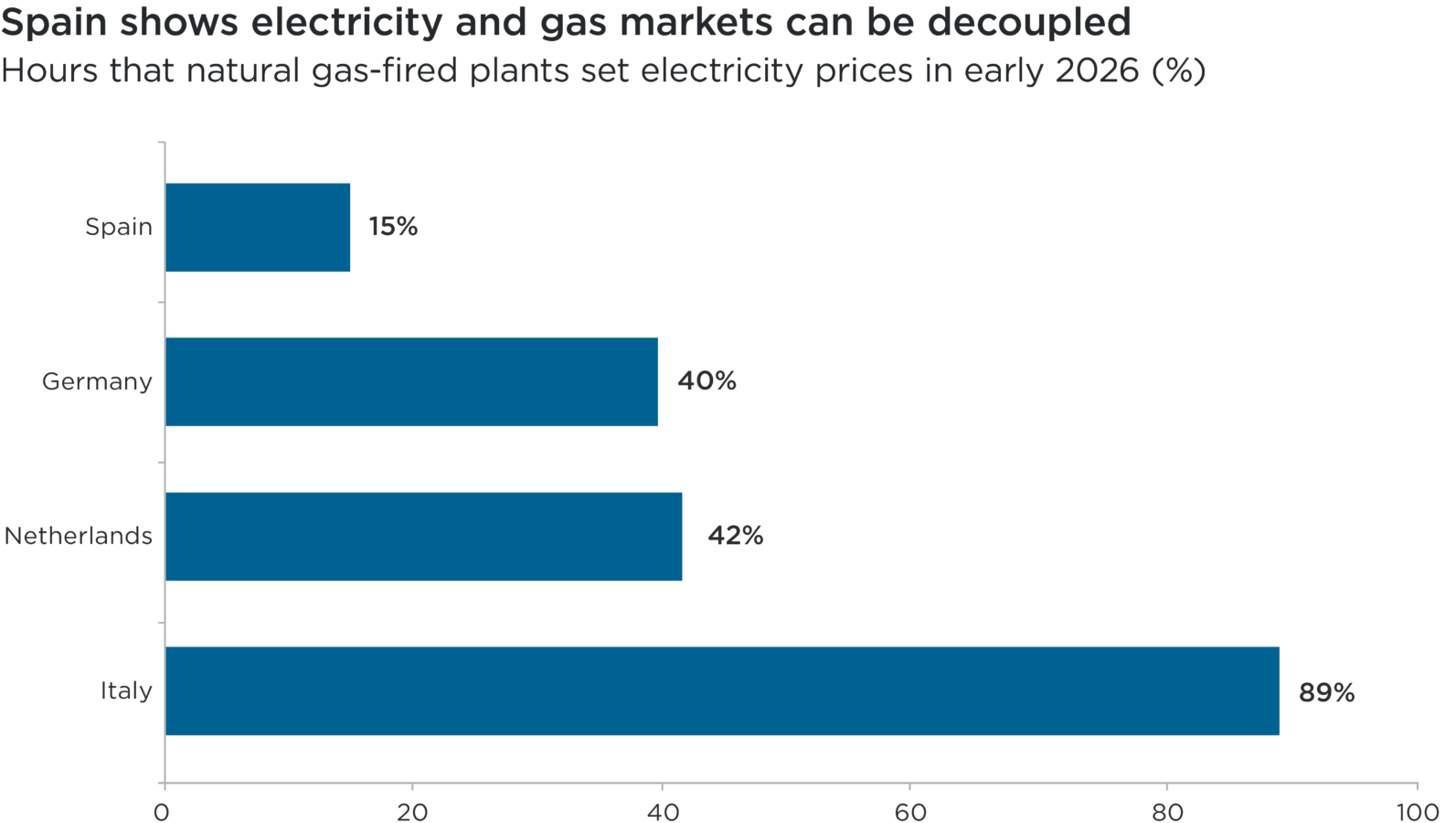
Source: Montel, GME, MIBGAS, ENTSO-E. Period from 1 January 2026 to 10 March 2026
Subhead: Hours that natural gas-fired plants set electricity prices in early 2026 (%)
Overview: This bar chart shows the proportion of time that electricity prices were determined by the cost of natural gas-powered generation in four selected European countries – Germany, Italy, the Netherlands and Spain – in early 2026. The period covered is 1 January 2026 to 10 March 2026.
Overall, this chart highlights the contrast between Italy and Spain. In Italy, the cost of gas determined electricity prices 89% of the time. In Spain, it was only 15%.
Ultimately, we believe that the energy shock created by the Middle East conflict will only accelerate Europe’s energy transition. Improved economics, as well as energy security imperatives, support numerous opportunities to deploy capital within the region’s renewables sector.
As well as new generation assets – increasingly co-located with battery storage – there is added potential for follow-on investments in repowering and life extension strategies that boost output, improve capacity factors and enhance rates of return on de-risked sites. The rise of decentralised generation meanwhile supports an array of opportunities in financing solutions for user-generators.
Investor selectivity remains key, though. Not all European markets offer equal opportunities given disparities in local grid electricity prices, national regulations and government support.
Nonetheless, investments in this space can offer predictable, long-duration cash-flows over multi-decade asset lifecycles that are often inflation-linked and contracted. At a time of acute market volatility, this can help to underpin portfolio stability while also offering potential to outperform in periods of elevated energy prices.
1 IEA, 2025
2 European Commission, 2026
3 Brent crude oil prices (US$) and the Platts JKM LNG benchmark (US$), as at 27 March 2026
4 IEA, 2026
5 Montel, October 2025: European electricity market summary – Q3 2025
6 Bloomberg, 30 March 2026. Based on differences between electricity price forward curves, by delivery date, pre and post-energy shock
7 Eurostat, May 2025: Oil and petroleum products- a statistical overview
8 Impax analysis of data from OPEC, 2024: Annual Statistical Bulletin 2024 and Energy Institute, 2025: Statistical Review of World Energy
9 European Commission, 2026
10 White, S., 9 November 2025: EDF boss vows to speed up nuclear projects and narrow gap to Asian peers. Financial Times
11 Euratom Supply Agency, 2025: Market Observatory
12 IEA, 2026: Electricity 2026
13 International Renewable Energy Agency, 2025: Renewable Power Generation Costs in 2024
14 S&P Global, May 2025: US gas-fired turbine wait times as much as seven years; costs up sharply
15 Bloomberg NEF, December 2025: Lithium-ion battery price survey
16 S&P Global, January 2026: EU installs record 27 GWh of battery storage capacity in 2025: SolarPower Europe
17 SolarPower Europe, January 2026: EU Battery Storage Market Review 2025
18 Financial Times, 19 March 2026: Spain is a role model in weathering Iranian oil shocks. In 2025, Spain generated 42% of its electricity from wind and solar, combined (Source: Ember, 2026)
Nothing presented herein is intended to constitute investment advice and no investment decision should be made solely based on this information. Nothing presented should be construed as a recommendation to purchase or sell a particular type of security or follow any investment technique or strategy. Information presented herein reflects Impax Asset Management’s views at a particular time. Such views are subject to change at any point, and Impax Asset Management shall not be obligated to provide any notice. Forward-looking statements or forecasts herein are subject to known and unknown risks and uncertainties including inaccurate assumptions that could cause actual results to differ materially from those expected or implied by the forward-looking statements. . While Impax Asset Management has made reasonable efforts to obtain information from reliable sources, we make no representations or warranties as to the accuracy, reliability or completeness of third-party information presented herein. No guarantee of investment performance is being provided and no inference to the contrary should be made.