
 United States
There is little doubt that AI is already reshaping parts of the jobs market. Goldman Sachs estimates net AI-related job losses of around 11,000 per month in the US, with entry-level and young white-collar workers bearing the greatest losses.1
The potential disruption to society will depend not only on the pace of technological adoption, but how well workforces can adapt or protect themselves from displacement. Government policy is critical to managing the systemic risks posed by AI.
Companies, and by extension their investors, face both opportunities and risks from labour market disruption and productivity enhancements from AI adoption. This includes the impacts of AI on corporate culture, which we observe to be a foundation of long-term company performance and resilience.
To navigate risks as they integrate AI into their businesses, we identify four crucial elements of an AI-ready corporate culture – from ensuring board oversight to managing threats to employee sentiment.
AI is reshaping labour markets
Fears of mass unemployment from the adoption of AI tools have not yet been realised, but meaningful disruption to some parts of the employment market is underway.
Isolating the effects of AI adoption is challenging for labour market analysts, given the range of other macroeconomic variables at work and the relatively short time period of analysis, but there is a correlation between AI adoption and the fall in graduate roles.2 A recent study finds that early career workers in the most AI-exposed occupations have experienced a 16% decline in employment, even when controlling for firm-level effects.3
AI will almost certainly accelerate role displacement in certain functions – anywhere between 3% and 14%, according to Goldman Sachs research, which estimates 6% to 7% as a baseline case based on an examination of more than 800 occupations.4
McKinsey’s analysis categorises work-hours in the US economy by their potential to be automated, either by AI agents or physical robots. It estimates that 44% of total US work-hours are non-physical and could be automated – although this figure drops to 36% once roles that require social and emotional capabilities are removed.5
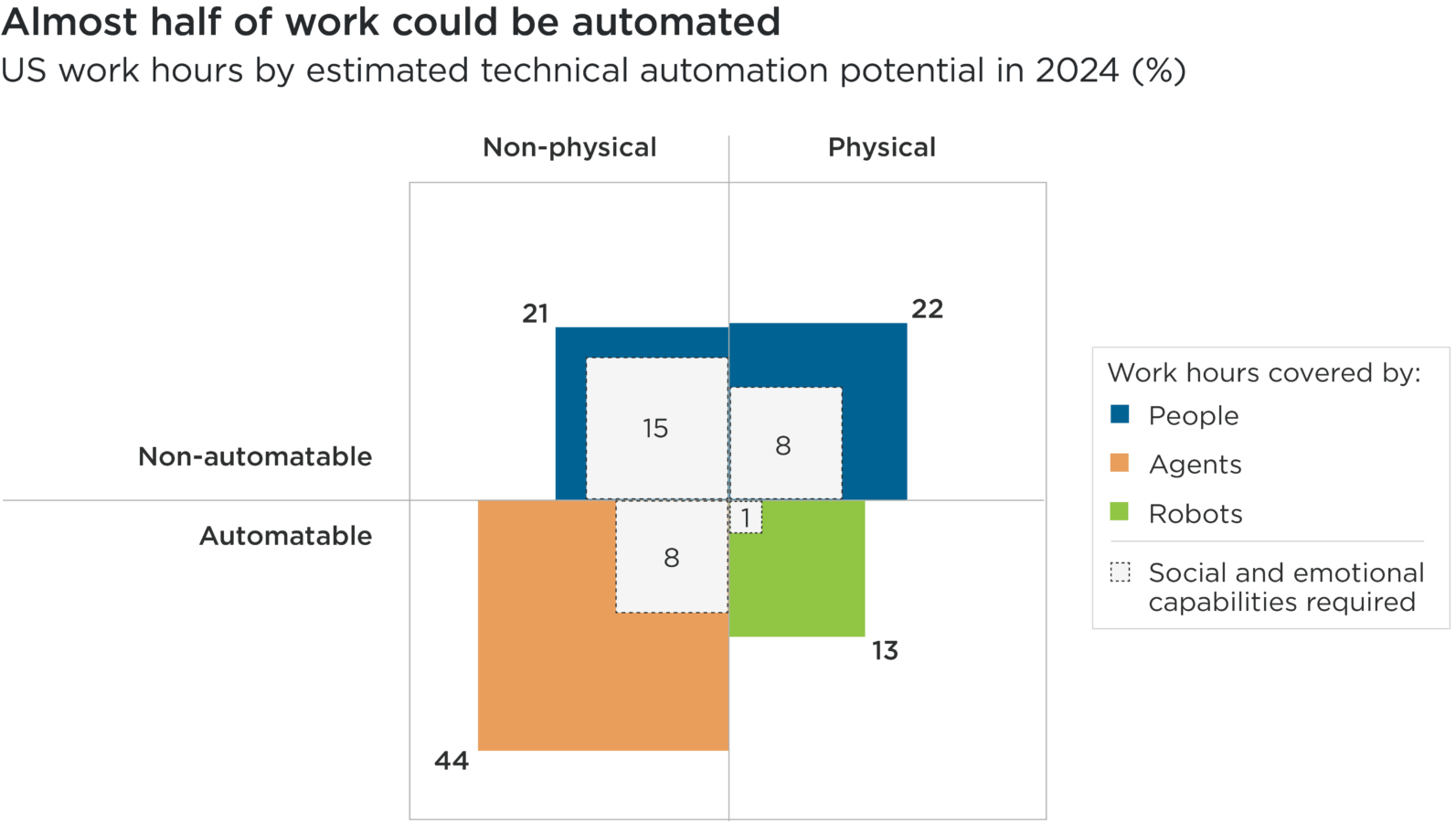
Source: McKinsey, 2025: Agents, robots, and us: Skill partnerships in the age of AI
Great uncertainty exists, however, on what the net impact will ultimately be on employment. In the short-term, indicators point towards a decline in employment: a recent McKinsey survey found that 32% of companies expected AI to reduce their overall workforce size (although only 14% actually reported reductions in their workforce by mid-2026). In parallel, 13% of companies expected that AI would lead to an increase in headcount, with 8% reporting AI-related increases in total employment by mid-2026.6
In the longer term, history suggests that new roles could be created elsewhere in the economy; it is estimated that 60% of US workers are in occupations that didn’t exist in 1940, for instance.7
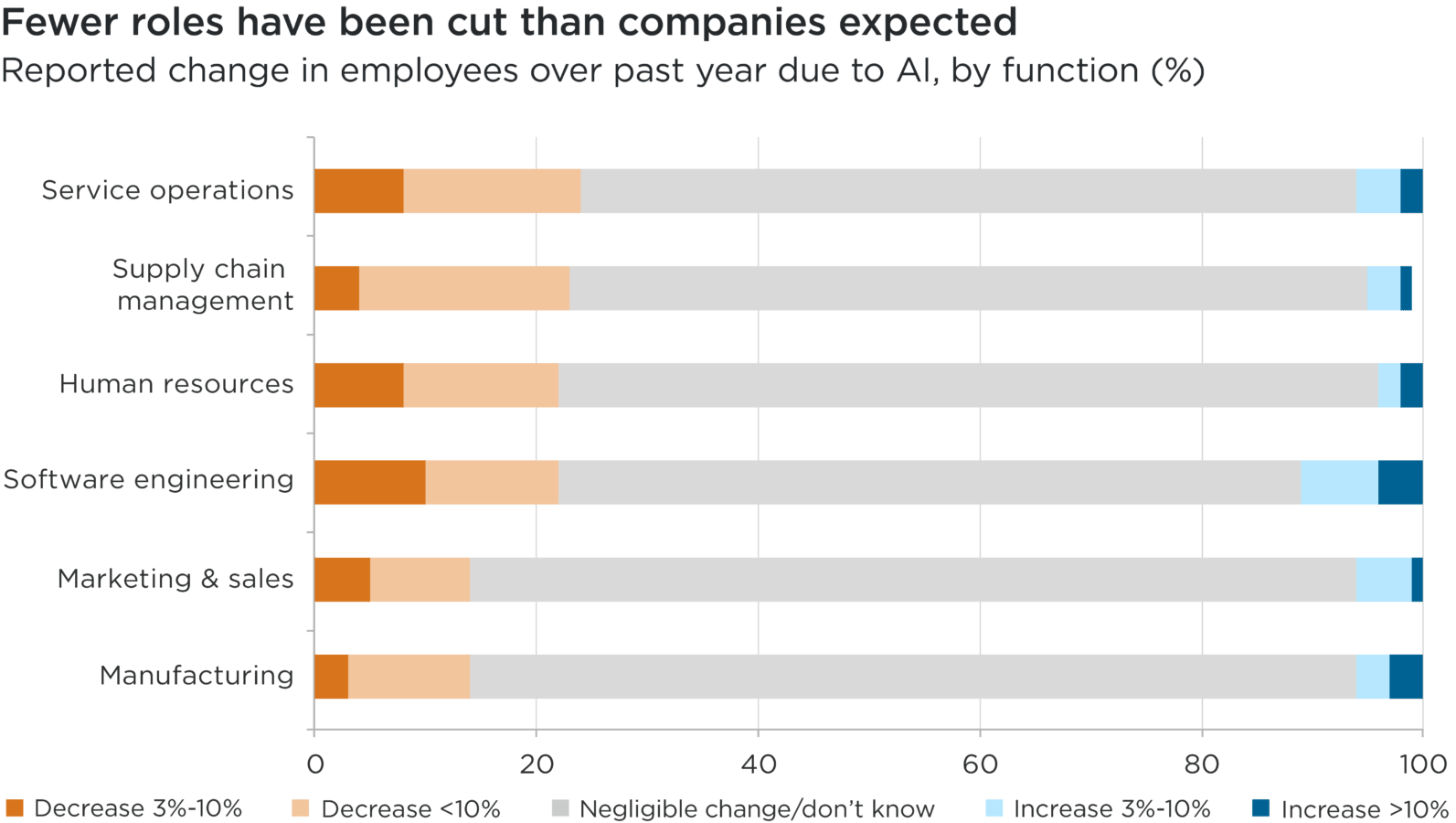
Source: McKinsey, August 2026: The state of AI in 2026: On the road to ROI. Selected occupations are included in the chart.
Irrespective of the eventual effect on net employment, a structural shift in the nature of work has begun. It is increasingly evident that a linear career path is not guaranteed and that new professional skills are needed for the AI age. Demand for AI fluency has grown sevenfold in two years, faster than for any other skill in US job postings. The number of workers in occupations where AI fluency is explicitly required has risen from around 1mn in 2023 to about 7mn in 2025 (see chart below).8
The World Economic Forum (WEF) finds that 59% of workers globally are projected to require reskilling or upskilling by 2030, driven by AI, demographic, sustainable transition and geoeconomic pressures collectively. Yet, given unequal access to opportunities, 11 of every 100 workers are unlikely to receive such training, according to the WEF.9

Source: McKinsey, 2025: Agents, robots, and us: Skill partnerships in the age of AI.
STEM roles include the following Standard Occupational Classification occupation groups: computer and mathematical occupations; architecture and engineering occupations; life, physical and social science occupations; and healthcare practioners and technical occupations.
Societal impacts and systemic risks depend on multiple actors
The societal and labour force impacts resulting from AI hinge on technological advances and their adoption by companies, the support of governments for displaced workers, and the preparedness of workforces to adapt.
In a ‘best-case’ scenario, where AI is seen as an opportunity and not as a threat to workers, the WEF envisages a ‘co-pilot economy’ in which human-AI teams reshape value chains and business models incrementally.10
This ‘best case’ scenario is, however, dependent on the availability and accessibility of retraining pathways and the adequacy of social safety nets to support people transitioning between jobs. This will largely depend on political choices. In California, an executive order focused on understanding the labour market impact of AI includes a comparative safety net review.11 In Europe, the EU Contingent Action Plan provides a skills guarantee for workers in sectors undergoing restructuring and risk of displacement.12 It is possible that AI-enabled prosperity can be inclusive and not detrimental to societal cohesion.
It is also possible to envisage a ‘worst-case’ scenario in which there is a rapid displacement of jobs that, with limited training and poor social safety nets, could lead to widening income inequality, political polarisation and rising fiscal pressure as income tax bases narrow.13,14,15
These risks are systemic in nature. They can affect all asset classes and reach across portfolios. The most meaningful approach for asset managers and owners to help reduce these risks is therefore to try and influence policymakers and peers, in what we call systematic stewardship.
Company-specific risks for investors
Since no single company’s behaviour will prevent these systemic risks from manifesting, company engagement should instead focus on risks that are within the control of management.
In our engagements, we look to assess how companies are navigating the workforce transition as they increasingly integrate AI into their businesses. There are four factors that we consider to be essential in developing an AI-ready corporate culture.
1. Strategic vision
As the potential applications and benefits of AI continue to expand, the companies capturing the greatest value are those with a clear strategic vision for how AI can strengthen their long-term competitive advantage. This vision should be supported by board-level oversight and embedded within the company’s broader corporate strategy.
Without a clear understanding of what successful AI adoption looks like, organisations risk misallocating time, capital and talent, while failing to capture value from employee-led innovation. A well-articulated AI strategy helps ensure that AI deployment supports sustainable value creation and resilience, rather than being driven primarily by short-term cost reductions.16
Restructuring at fintech company Klarna illustrates how mismanaged AI adoption presents company-specific risks. Between 2022 and 2024, Klarna eliminated approximately 700 roles, primarily in customer service and support, and replaced them with an AI assistant developed in partnership with OpenAI. In 2025, however, it acknowledged that aggressive restructuring driven by labour cost reduction led to diminished service quality and that, following increased customer dissatisfaction, it would subsequently rehire human staff.17
2. Accountability in decision making
As AI systems assume enhanced roles in consequential decision-making, companies that fail to maintain clear lines of accountability and effective human oversight face regulatory exposure, reputational risk and operational liabilities.18
However, simply keeping a ‘human in the loop’ may not be sufficient. Emerging evidence suggests that managers can become less likely to identify errors when work is performed by AI agents that are treated as capable colleagues or employees, creating a risk of over-reliance and reduced scrutiny.19,20
Organisations must not only retain human decision-makers, but also ensure those individuals are trained to understand the limitations of AI systems, critically evaluate AI-generated outputs and remain ultimately accountable for decisions and outcomes.
The potential reputational damage caused by oversight failures is illustrated by the case of Deloitte in Australia. Academics highlighted a litany of errors, including made-up references, in a report produced by the consultancy in mid-2025 for the Australian government.21 Deloitte subsequently admitted that AI had been used without robust oversight and repaid some of its fee.22
3. Development of the talent pipeline
The adoption of AI tools within service industries is compressing or eliminating many of the entry-level roles that have historically served as the foundation of professional development. In the long run, this could lead to capability deficits and succession risk. At the same time, there is a shorter-term risk that companies do not ensure workers have the right skills to use AI effectively.
Some companies are responding proactively through reskilling their staff. Instead of laying off call centre workers whose jobs had been largely displaced by AI chatbots, Swedish furniture company Ikea retrained them to handle more complex customer queries or to work as interior design sales advisors.23 They may be in the minority, however; based on an assessment of public disclosures, only 14% of companies evidence policies or mechanisms to mitigate the negative impacts of AI systems on workers.24
4. Employee sentiment
AI’s effects on employee sentiment are highly dependent on the strategic clarity around how AI is being used, the level of management support and opportunities for professional development. Fears of displacement by AI are commonplace.25 Risks of disengagement exist where use of AI is opaque and lacks human judgement in areas requiring high level of trust, as in performance management and compensation, for example.
Companies that are monitoring employee sentiment – a valuable but overlooked aspect of corporate culture – and inviting feedback are best placed, in our view, to act early to improve workforce engagement levels and ensure continued value from AI integration.
Gallup research finds that when workers in AI-adopting organisations have a clear AI implementation plan, and active manager support, employee engagement rises to 53%. Manager support remains key in communicating expectations, helping employees to navigate where AI adds value and where human oversight remains critical.26 This aligns with the findings from Microsoft’s 2026 Work Trend Index Report, which emphasises that organisational factors shape AI’s real impact (67%) much more than individual mindsets and behaviours (32%).27
Focusing our company engagements
Based on these risks and where they are manifesting, we have chosen to prioritise engagements with financial and healthcare companies.
AI is being embedded in core decision-making in these sectors, with errors or biases carrying direct financial, legal or safety risks. Within financials, for instance, AI is now embedded within underwriting and credit assessment. Within healthcare, it plays an increasingly important role within diagnosis and surgery.
These are both sectors where human judgment remains critical: AI can augment decision-making, but not replace it. Corporate culture remains a key determinant of whether AI is used responsibly and whether risks arising from AI misuse are managed.
They are also both sectors where there is potential for large-scale workforce disruption from AI adoption. This carries elevated reskilling and restructuring requirements for companies, who must also manage higher risks pertaining to employee sentiment.
By engaging with our investee companies, we continue to look to mitigate the risks that AI poses to corporate culture.
1 Lichtenberg, N., 1 June 2026: Gen Z is losing the most in the AI economy – and Goldman warns it’s about to get worse. Fortune.
2 Murray, C. et al, 24 July 2025: Is AI killing graduate jobs? Financial Times
3 Brynjolfsson, E., Chandar, B. & Chen, R., 2025. Canaries in the Coal Mine? Six Facts about the Recent Employment Effects of Artificial Intelligence. Stanford Digital Economy Lab
4 Goldman Sachs, 2025: How Will AI Affect the Global Workforce?
5 McKinsey Global Institute, 2025: Agents, robots, and us: Skill partnerships in the age of AI
6 McKinsey, August 2026: The state of AI in 2026: On the road to ROI
7 Autor, D. et al., 2024: New Frontiers: The Origins and Content of New Work, 1940–2018. The Quarterly Journal of Economics
8 McKinsey Global Institute, 2025: Agents, robots, and us: Skill partnerships in the age of AI
9 World Economic Forum, 2025: Future of Jobs Report 2025. Figures are based on employers’ self-reported expectations in the WEF Future of Jobs Survey 2024 (~1,000 large employers, 22 industries, 55 economies), not an independent assessment of training needs or outcomes, and reflect employer sentiment. The underlying dataset covers roughly 1.18 billion formally employed workers globally out of an ILO-estimated 2.18–2.76 billion, so the figures should be read as proportions within surveyed large-employer populations rather than the full global workforce
10 World Economic Forum, 2026: Four futures for jobs in the new economy: AI and talent in 2030
11 California Executive Order N-6-26
12 European Commission, 2026: AI talent, skills and literacy
13 The impact of AI on income inequality is debated. While it is possible that automation disproportionately affects lower skilled workers (see Acemoglu, D. & Restrepo, P., 2024: A task-based approach to inequality. Oxford Open Economics). AI could compress wage inequality if the impacts are concentrated on higher-wage office-based roles (see Teeselink, B.K., 2025: Generative AI and Labor Market Outcomes: Evidence from the United Kingdom)
14 Research has linked automation-driven economic insecurity to rising populist support across the US and Europe (see Jacobs, J., Tasin, F. & Mannan, A.J., 2024: Does automation increase support for the far right? Brookings)
15 As automation’s share of production rises, there is a structural limit to how much revenue labour taxation can ever raise (see Korinek, A. & Lockwood, L.M., January 2026: Public finance in the age of AI: A primer. Center on Regulation and Markets at Brookings). Meanwhile, increased social spending pressures rise, both due to creation of retraining infrastructure and social safety nets as workers transition between jobs (see IMF, April 2026: Global Economic and Financial Implications of Artificial Intelligence: Lessons from a Scenario Planning Exercise).
16 Peregrine, M.W., 18 December 2025: Board Oversight Of AI-Driven Workforce Displacement. Harvard Law School Forum on Corporate Governance
17 MLQ, 2025: Klarna CEO admits aggressive AI job cuts went too far, starts hiring again after US IPO
18 Scheiber, N., 29 June 2026: A.I. ‘Employees’ Might Disrupt Work in Unexpected Ways. The New York Times
19 Scheiber, N., 29 June 2026: A.I. ‘Employees’ Might Disrupt Work in Unexpected Ways. The New York Times
20 Wiles. E. et al., September 2026: Putting AI on the Org Chart: Evidence on Delegation and Accountability. This study finds that presenting drafts as produced by an AI employee, rather than by an AI tool, reduces the share of errors detected by 17%, increases requests for additional review by 22 percentage points, and shifts perceived accountability towards the AI system.
21 Karp. P., 22 August 2025: Academics raise alarm over suspected AI use in Deloitte report. Australian Financial Review
22 Dhanji, K., 6 October 2025: Deloitte to pay money back to Albanese government after using AI in $440,000 report. The Guardian
23 Zillman, C., 30 July 2026: Inside Ikea’s big bet on humans in the age of AI. Fortune
24 UNESCO & Thomson Reuters Foundation, 2026: Responsible AI in Practice: 2025 Global Insights from the AI Company Data Initiative. Based on an analysis of 2,972 companies
25 Partridge, J., 25 January 2026. More than a quarter of Britons say they fear losing jobs to AI in next five years. The Guardian
26 Gallup, July 2026: Employee Engagement Remains Flat as AI Adoption Accelerates
27 Microsoft, May 2026: 2026 Work Trend Index report: Agents, human agency and the opportunity for every organization
References to specific securities are for illustrative purposes only and should not be considered as a recommendation to buy or sell. Nothing presented herein is intended to constitute investment advice and no investment decision should be made solely based on this information. Nothing presented should be construed as a recommendation to purchase or sell a particular type of security or follow any investment technique or strategy. Information presented herein reflects Impax Asset Management’s views at a particular time. Such views are subject to change at any point and Impax Asset Management shall not be obligated to provide any notice. Any forward-looking statements or forecasts are based on assumptions and actual results are expected to vary. While Impax Asset Management has used reasonable efforts to obtain information from reliable sources, we make no representations or warranties as to the accuracy, reliability or completeness of third-party information presented herein. No guarantee of investment performance is being provided and no inference to the contrary should be made.