
 United States
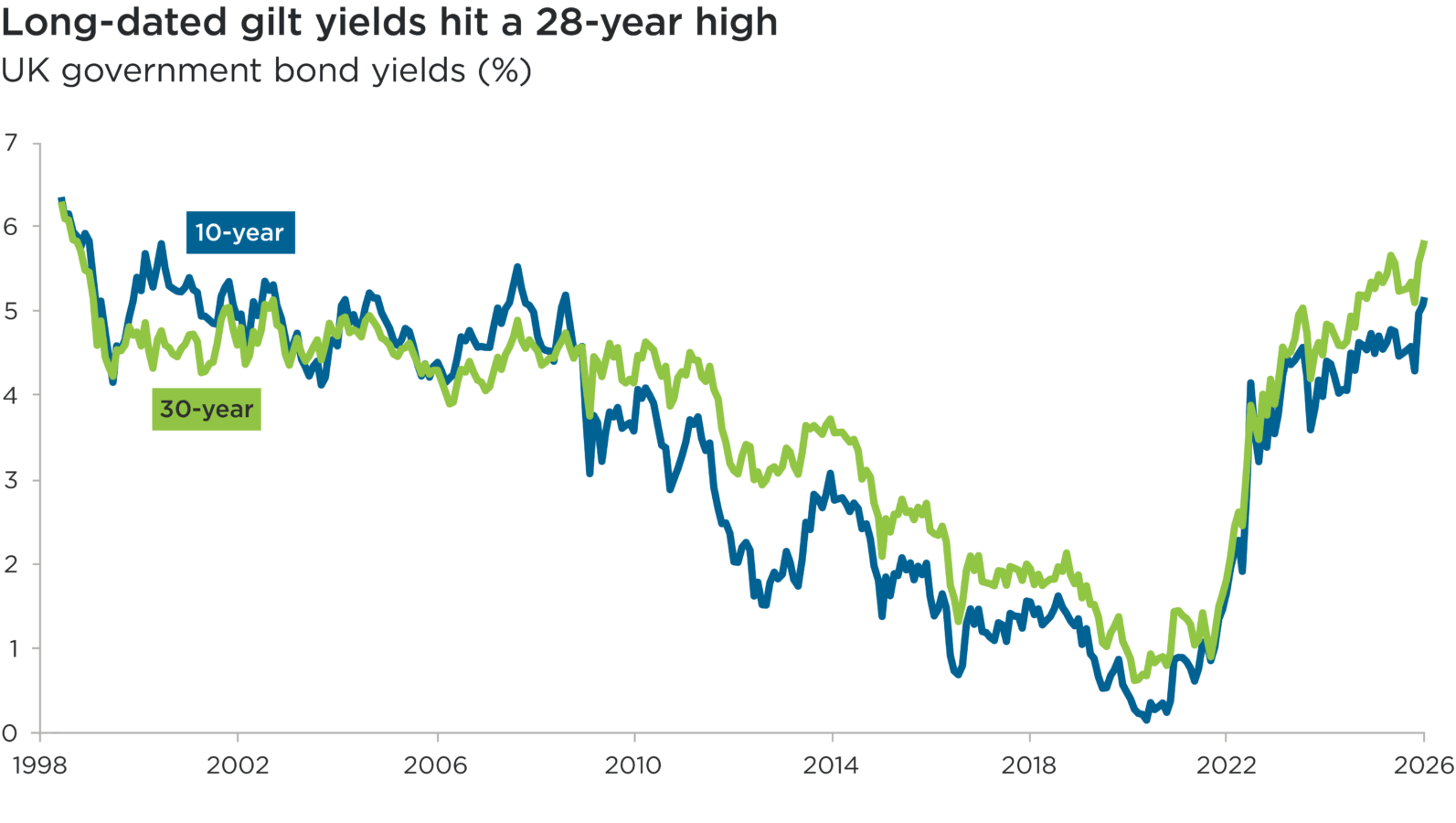
UK government bond yields have risen sharply once again. While 10-year gilt yields reached their highest point since 2008, yields on 30-year bonds have edged up towards 6% – levels not seen since the late 1990s (see chart below).
A combination of factors lies behind the latest uptick in UK government borrowing costs. Compounding the Bank of England’s novel approach to ‘quantitative tightening’ – actively selling gilts accumulated during a decade or so of ‘quantitative easing’ – are two acute factors: energy shock-driven inflation and political instability against a poor fiscal backdrop.
Gilt markets are an important watch item for corporate credit investors since they set a floor for the valuations of sterling-denominated credit. In a tightly correlated G7 rates complex, and given the international nature of many UK businesses, volatile gilt yields could transmit to global credit valuations, too.
Source: Bloomberg data, 11 May 2026
Subhead: UK government bond yields (%)
Overview: This line chart compares the yields on 10-year and 30-year UK government bonds (or gilts) between 1998 and May 2026.
Overall, this chart illustrates how both 10-year and 30-year gilt yields have risen sharply since 2022, having gradually fallen since 1998.
Quantitative tightening is still underway
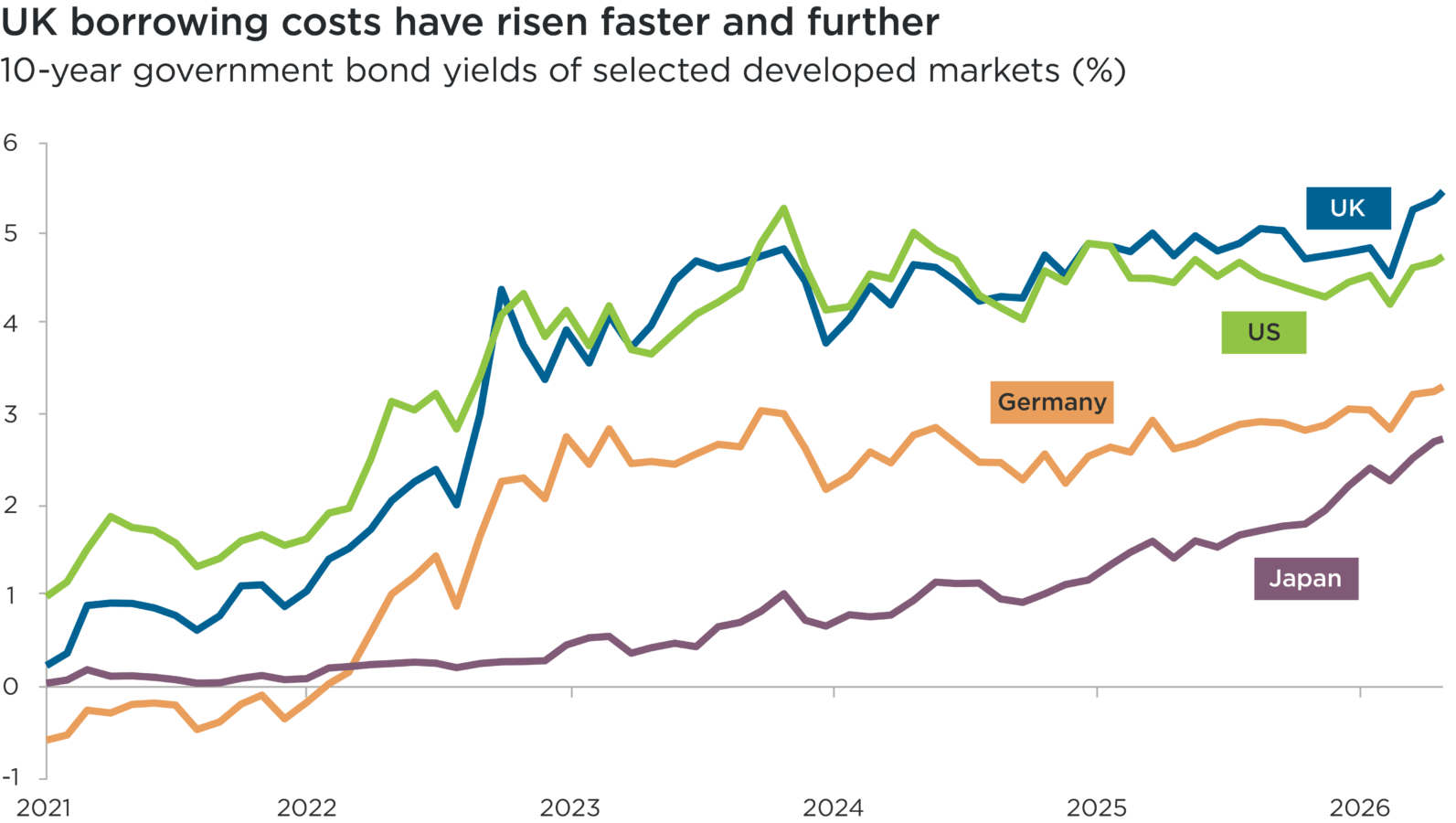
As we wrote last year, the Bank of England’s policy of quantitative tightening continues to contribute to gilt yields, which have risen further than other developed market government bonds (see chart below).
The UK central bank stands apart from its peers, the European Central Bank (ECB) and the US Federal Reserve (Fed). While both the ECB and the Fed continue to rely solely on bonds maturing to run down their vast stocks of accumulated government debt, the Bank of England has been actively selling theirs down.
The pace of gilt sales has admittedly slowed, with the Bank’s annual gilt reduction target falling from £100bn to £70bn between September 2025 and September 2026. Active sales in the first quarter of 2026 were just £5.5bn.1
Nonetheless, active gilt sales increase supply at a time when the market is absorbing heavy issuance to fund an annual government deficit that continues to exceed 4% of GDP.2 In the context of public net sector debt that is touching 100% of GDP, this inevitably keeps upward pressure at the longer end of the yield curve.3
Source: Bloomberg data, 11 May 2026
Subhead: 10-year government bond yields of selected developed markets (%)
Overview: This line chart shows the yields on 10-year bonds issued by the governments of the UK, the US, Germany and Japan, respectively, between 2021 and May 2026.
Overall, this chart illustrates how yields on all of these governments’ bonds have risen over the past five years, but that the cost of UK government borrowing has risen particularly sharply.
The energy price inflation shock
The UK’s dependence on energy imports is a structural challenge that reinforces the economy’s longstanding current account deficit. Recent conflict in the Middle East has made its implications more acute.
With the Strait of Hormuz effectively closed since the end of February, Brent crude oil has traded above US$100 per barrel, with the IEA estimating that the conflict is disrupting roughly 14% of global supply.4 Natural gas prices have also soared and the UK – where gas accounts for roughly 75% of domestic energy consumption – is particularly exposed.5
There is a clear inflation pass-through: the consumer price index rose to 3.3% in March, and the Bank of England revised its inflation projection upward by 1.4 percentage points.6 Markets are now pricing in interest rate rises of 50 basis points by year-end, in a sharp reversal of previous rate cut expectations for 2026.7
Political instability and fiscal credibility
Even before the energy shock, the UK’s independent fiscal watchdog lowered its projections for economic growth in 2026 to 1.1% and assessed fiscal headroom to be a very thin £1.9bn.8
With subdued growth, accelerating inflation and higher debt interest costs, the government’s space for fiscal adjustment is narrow – especially given Labour’s manifesto pledges to not raise income tax, VAT or employee national insurance.
For markets, the outcome of this May’s local and devolved government elections matters less than its implications for the UK’s fiscal credibility. With debates over the leadership and direction of the government intensifying, there is speculation over whether fiscal policy will become more permissive. The UK gilt market has historically punished political uncertainty, and the additional risk premium currently priced into long-dated yields reflects that tendency.
Implications for sterling credit
For sterling-denominated corporate bonds, the gilt component is the dominant part of the all-in yield, given tight spreads. Volatility in the rates market therefore has an outsized impact on total returns, which has implications for how investors should think about duration and primary market conditions across sterling investment grade and high yield.
Spreads have so far remained relatively contained, suggesting that the market is treating the recent spike in gilt yields as a rates story, rather than a credit one. We think that is broadly correct, but issuer-level dispersion (particularly around energy-sensitive credits and those with near-term refinancing needs) matters in this environment.
Our central view is that 10-year gilt yields remain in a 4.5 to 5.5% range in the near term, with risks skewed to the upside. While a diplomatic resolution of the Hormuz crisis would provide meaningful relief, a continuation or escalation of the conflict would – especially if combined with political volatility – exacerbate the drivers of surging gilt yields. Should they remain higher for longer, the floor for sterling corporate borrowing costs could materially rise.
1 Bank of England, May 2026: Asset Purchase Facility Quarterly Report – 2026 Q1 and Bank of England, September 2025: Market Notice
2 Office for National Statistics, March 2026: Public sector finances, UK
3 Office for National Statistics, March 2026: Public sector finances, UK
4 International Energy Agency / Bloomberg data, as at 8 May 2026
5 Ofgem, 2026
6 Bank of England, April 2026: Monetary Policy Report
7 Deloitte, 5 May 2026: UK interest rate outlook
8 Office for Budget Responsibility, Economic and Fiscal Outlook, March 2026
Nothing presented herein is intended to constitute investment advice and no investment decision should be made solely based on this information. Nothing presented should be construed as a recommendation to purchase or sell a particular type of security or follow any investment technique or strategy. Information presented herein reflects Impax Asset Management’s views at a particular time. Such views are subject to change at any point, and Impax Asset Management shall not be obligated to provide any notice. Forward-looking statements or forecasts herein are subject to known and unknown risks and uncertainties including inaccurate assumptions that could cause actual results to differ materially from those expected or implied by the forward-looking statements. . While Impax Asset Management has made reasonable efforts to obtain information from reliable sources, we make no representations or warranties as to the accuracy, reliability or completeness of third-party information presented herein. No guarantee of investment performance is being provided and no inference to the contrary should be made.