
 United States
At the start of 2025, we outlined four reasons why we were constructive on high yield bonds. Economic, market, structural and technical factors all looked supportive, despite tight credit spreads.
Those themes largely played out, with global high yield markets delivering total returns (in US dollars) of 8.5% in 2025.1
As we enter 2026, our base case for the asset class remains constructive. Although technical conditions are likely to be less favourable than in recent years, three of the four supportive factors that we cited a year ago remain intact.
We evaluate each, in turn, identifying risks to our positive outlook. Importantly, while these risks could trigger periods of market volatility, it is our conviction that they are less likely to undermine the fundamental return potential of the asset class.
1. The macroeconomic backdrop remains constructive
Early headlines in the new year have centred around geopolitics, but the global economy remains relatively robust, with GDP growth forecasts for 2026 mostly ranging between 2.5% and 3%, supported by a range of policy and structural tailwinds.
In the US, fiscal stimulus from the One Big Beautiful Bill, combined with a more deregulatory policy stance, should continue to support corporate earnings. Moderating inflation increases the likelihood that the Federal Reserve maintains a broadly accommodative monetary policy; two or three interest rate cuts are expected in 2026. In addition, substantial investment from the technology sector — especially related to the build-out of infrastructure enabling the deployment of artificial intelligence (AI), and in spite of debate about valuations — should provide incremental support to growth across the US economy, even as activity moderates in other sectors.
In Europe, meanwhile, higher government spending on defence and energy infrastructure is helping to offset competitive pressures facing certain industrial sectors. European banks are also on a firmer footing, with improving profitability and regulatory capital relief likely to support credit creation and lending activity.
Risks in perspective
There are signs of softening in the US economy, however, and this is important given the US comprises 57% of the global high yield market.2 While US inflation has moderated, it remains above the target rate of 2%.3 Additionally, US labour markets have also softened, with recent layoffs across several industries. Tariff-related pressures could also re-emerge, potentially complicating the policy outlook.
From a high yield perspective, we believe that these risks are mitigated by the absence of broad-based stress and generally strong corporate balance sheets: On average, US high yield companies have net leverage multiples of 3.9 times earnings, broadly in line with the 15-year average (3.8x). Furthermore, earnings growth remains positive and trending positively: earnings grew over the past 12 months by 4.8%, up from 1.7% at the end of 2024.4
We are also monitoring the risk of a slowdown in technology sector-led growth, particularly if AI-related investments fail to match expectations or if borrowing costs rise. In our view, such scenarios would most likely manifest through equity market volatility and wider credit spreads, rather than a sharp increase in defaults.
Taken together, while macroeconomic risks warrant attention, they do not undermine our base-case expectation of sustained economic expansion that should be supportive for high yield assets.
2. Absolute yields remain high, default rates are low
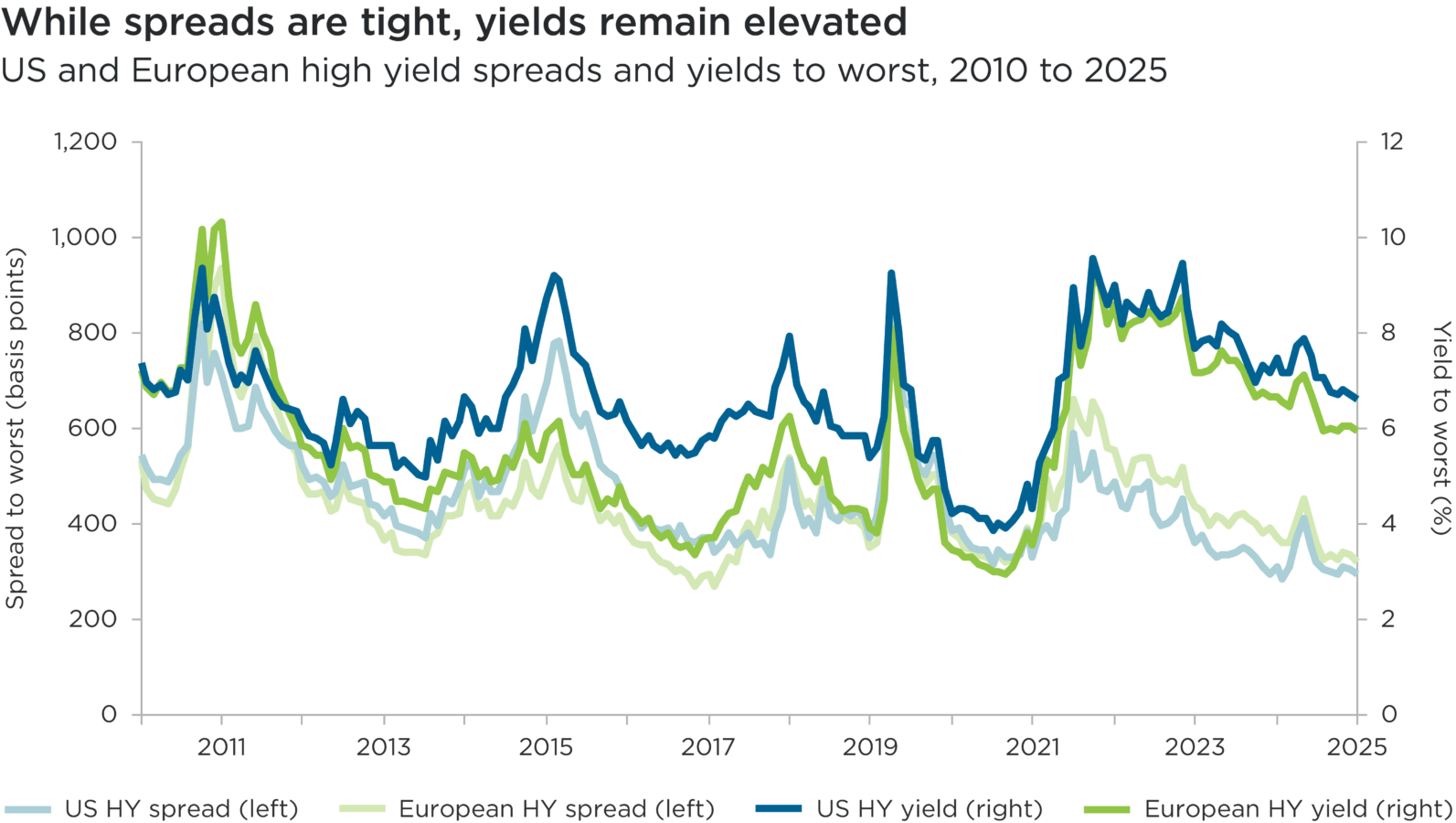
Even after a strong 2025, US high yield bonds continue to offer absolute yields in line with the average over the past decade. Their European counterparts offer overall yields more than 40 basis points above their 10-year average.5
Starting yields have historically been the primary driver of medium-term returns for investors in the asset class. This dynamic is especially powerful when default rates are low, as they were in 2025, with a US high yield 12-month trailing default rate of 1.2% and a European rate of 2%.6 Expectations for defaults in 2026 remain well below long-term averages.
Projections of only moderate default rates are underpinned by strong credit fundamentals. Stable leverage metrics and profit growth, as previously described, should support US companies, and leverage in Europe is also not elevated (net debt-to-earnings ratio of 3.8).7 Globally, the high yield ‘maturity wall’ does not look concerning, either, with most maturities pushed out until 2028 and beyond.
Past performance is not indicative of future returns.
Source: Bloomberg data, 31 December 2025. Period 31 December 2010 to 31 December 2025.
‘US High Yield (HY)’ = ICE BofA US High Yield Index
‘European High Yield (HY)’ = ICE BofA Euro High Yield Constrained Index
Indices are unmanaged and not available for direct investment
Subhead: US and European high yield spreads and yields to worst, 2010 to 2025
Overview: This line chart compares the spreads and yields to worst of US and European high yield markets, from 31 December 2010 to 31 December 2025. Spreads (measured in basis points) reference the left-hand y-axis. Yields (%) reference the right-hand axis.
Overall, this chart illustrates how spreads and yields have diverged since 2022, for both US and European high yield bonds. While both US and European high yield spreads have generally continued to decline, their yields sit at around levels seen at the start of the period.
Risks in perspective
While rising longer-term interest rates would present a headwind, the relatively short duration of the high yield market (approximately 3.0 years) limits sensitivity to rate moves.
Given historically tight levels, spread widening is a more relevant risk, particularly in the event of an equity market correction. Even in that scenario, however, carry remains a powerful offset given starting yields are elevated, and the breakeven profile of the high yield market appears attractive For example, we estimate that yields would have to move more than 200 basis higher (through the net effect of potentially contrasting rate and spread moves) to experience a negative total return over a 12-month period.
Default risk remains contained at the index level, in our view, although stress is more pronounced in specific sectors such as chemicals, paper, building materials and certain media sub-sectors. These pressures reinforce the importance of issuer selection rather than signalling a broad deterioration in credit quality.
3. Market structure has improved – in contrast to private credit
The structural characteristics of the global high yield market are materially stronger than in prior cycles.
Overall credit quality has improved, with the global high yield market rated at ‘BB-’ on average. Importantly, around 62% of the market is now rated ‘BB’, compared to around a third at the turn of the century.8 Duration has declined to roughly 3.0 years – its lowest-ever level and 1.2 years lower than the last peak, seen in mid-2022 – and sector diversification has broadened.9 An active primary market has also allowed issuers to extend maturities, reducing near-term refinancing needs.
These improvements stand in contrast to developments in other parts of the leveraged loan universe. Credit quality in this market has deteriorated, sector concentrations have increased and borrower protections have weakened.
More notable concerns are emerging in private credit, where borrower opacity, aggressive underwriting and rising default rates — particularly among smaller companies — are drawing increased scrutiny. While the rapid expansion of private credit has been celebrated for its bespoke nature, recent collapses, including those of First Brands and Tricolor, have exposed deep cracks in the sector’s plumbing.
Risks in perspective
The risk of contagion from private credit failures cannot be entirely dismissed. The scale of private credit and its de facto role as the marginal source of corporate finance means the fallout of any string of failures would likely leach into public markets.
Notwithstanding this risk, the attributes of today’s high yield market – including credit quality and stronger market transparency – should help limit the potential downside for investors if market volatility increases. The warning signs in private credit, such as the rise of payment-in-kind arrangements and overleveraged portfolios, contrast sharply with the improved credit quality of the high yield universe.
Ultimately, recent private credit failures serve as a reminder that transparency and liquidity are not just features of the public high yield market, but essential protections for investors.
Technical factors are less supportive, but not decisive
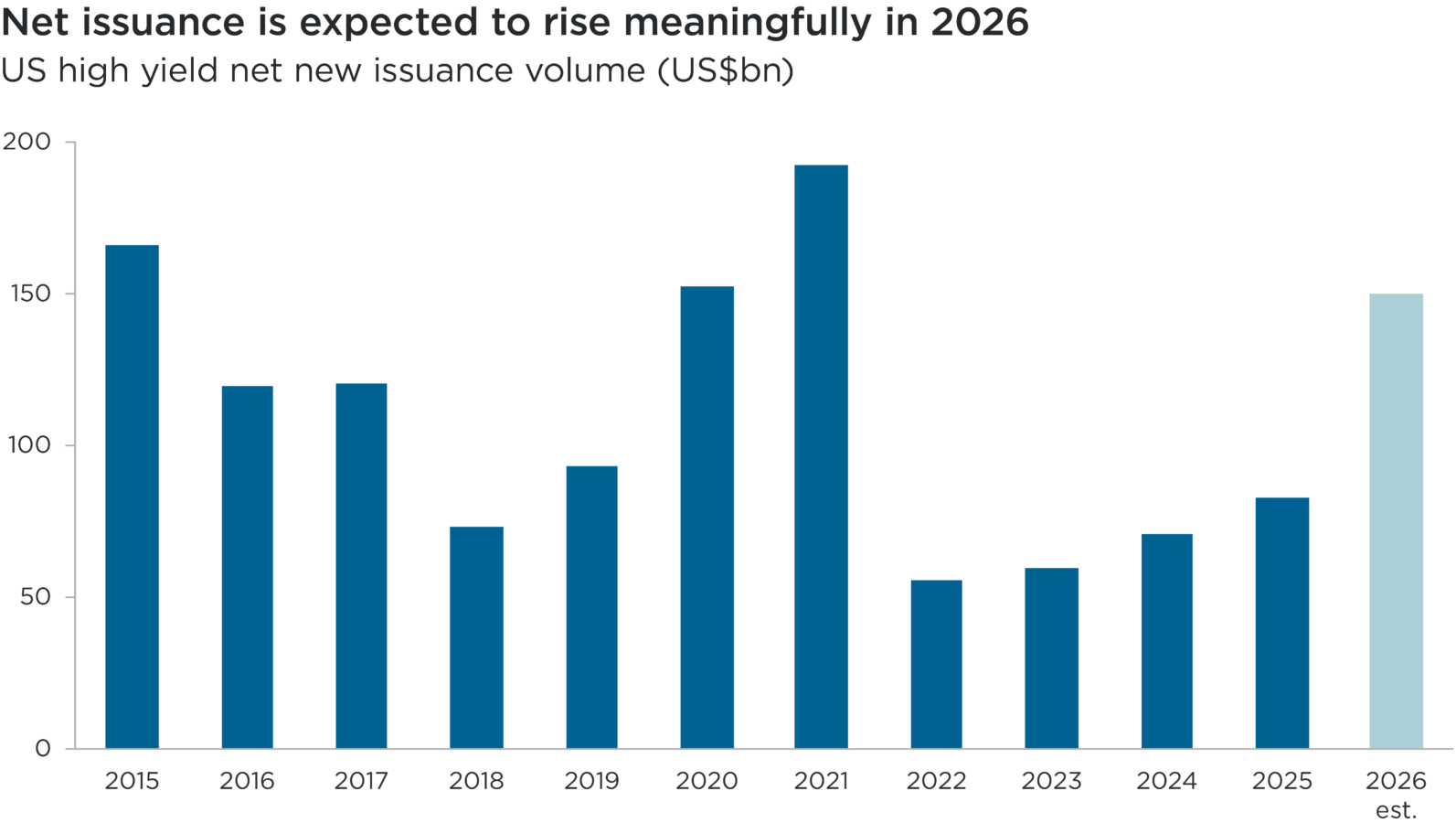
It should be noted that technical conditions are likely to be less favourable in 2026 than in 2025 as the supply of high yield bonds is expected to rise meaningfully.
Net new issuance is forecast to exceed historical averages. A larger share of issuance is expected to fund leveraged buyouts, mergers and acquisitions, and shareholder distributions. These uses of proceeds are typically associated with lower-rated debt, although will largely be dictated by market directionality: after all, positive market dynamics can accommodate more aggressive issuance.
While higher net supply could put upward pressure on spreads if investors’ risk appetite weakens, it alone is unlikely to derail the market. Crucially too, higher yields and improved fundamentals should provide a cushion against incremental technical headwinds.
Source: Impax analysis of JP Morgan research, January 2026. Historical data as at 5 January 2026. Data for 2026 is forecast, as at 23 December 2025. Net new issuance is gross issuance minus refinancing volumes.
Subhead: US high yield net new issuance volume (US$bn)
Overview: This bar chart shows the annual issuance of US high yield debt, from 2015 to 2025. Forecast data is included for 2026.
Overall, this chart illustrates how US high yield issuance is expected to recover in 2026 to its highest level since a peak in 2021. Issuance has been subdued since 2022, but has gradually risen year-on-year.
Grounds for (cautious) optimism
Volatility in the high yield market is likely to increase in 2026, particularly as net supply rises and macroeconomic risks evolve.
The asset class enters this period from a position of strength, though. High absolute yields, low expected default rates, an improved market structure and a broadly supportive economic backdrop provide a solid foundation for the pursuit of compelling risk-adjusted returns.
While selectivity and active risk management will be increasingly important to navigate a complex late cycle environment, we believe the fundamental investment case for high yield remains very much intact.
Past performance is not indicative of future returns.
1 ICE BofAML Global High Yield Index, returns hedged to US dollars, sourced from Bloomberg as at 31 December 2025
2 ICE BofAML Global, US and European high yield indices, sourced from Bloomberg as at 31 December 2025.
3 Bureau of Labor Statistics, November 2025
4 ICE BofA US Cash Pay High Yield Constrained Index, ICE BofA Global High Yield Index
5 Impax analysis of Bloomberg data, as at 18 December 2025
6 Bank of America, data as at 31 December 2025
7 Impax analysis of Bank of America data, as at 30 September 2025
8 Bloomberg data, based on ICE BofA Global High Yield Index as at 31 December 2025
9 Bloomberg data, based on ICE BofA Global High Yield Index as at 31 December 2025
Nothing presented herein is intended to constitute investment advice and no investment decision should be made solely based on this information. Nothing presented should be construed as a recommendation to purchase or sell a particular type of security or follow any investment technique or strategy. Information presented herein reflects Impax Asset Management’s views at a particular time. Such views are subject to change at any point, and Impax Asset Management shall not be obligated to provide any notice. Forward-looking statements or forecasts herein are subject to known and unknown risks and uncertainties including inaccurate assumptions that could cause actual results to differ materially from those expected or implied by the forward-looking statements. . While Impax Asset Management has made reasonable efforts to obtain information from reliable sources, we make no representations or warranties as to the accuracy, reliability or completeness of third-party information presented herein. No guarantee of investment performance is being provided and no inference to the contrary should be made.