
 United States
After eight decades as the world’s primary reserve currency, the US dollar’s dominance of global finance is gradually slipping. This trend of ‘de-dollarisation’, accelerated by geopolitics and mounting US fiscal risks, is now reshaping the market for hard currency emerging market (EM) corporate bonds.
Issuance of euro-denominated EM credit, in particular, continues to rise. With increased liquidity and selective spread advantages over US dollar-denominated debt, we believe the expanding investable universe of euro EM bonds will support opportunities for investors.
A rotation within hard currency issuance
Emerging market companies have historically relied heavily on US dollar-denominated bond issuance to tap into global capital.
Local currency bonds provide a natural hedge for companies with domestic revenue streams, but often have limited appeal to overseas investors who typically face high currency hedging costs. Greater liquidity and deeper investor pools have made the US dollar the hard currency of choice for most EM corporate issuers, and it is likely to remain dominant in the US$2.6tn EM non-local currency credit market.1
Demand for alternatives is rising, though, as global investors seek to mitigate dollar volatility and US fiscal and policy risks, perceptions of which have exacerbated by the recent ‘One Big Beautiful Bill’ and the introduction of punitive import tariffs. Rising concerns are reflected in ex-US investor outflows from US-denominated credit following the ‘Liberation Day’ tariff announcements on 2 April 2025.2
Market depth, liquidity and momentum make euro-denominated bonds the most likely hard currency alternative for EM corporate issuers. The value of the euro EM credit universe currently stands at around US$220bn – roughly half the size of the European high yield bond market.3
Euro-denominated bonds only account for 9% of the EM hard currency debt in issuance, but this share has been rising: euro EM credit stock has almost doubled in value since 2013, while that issued in other hard currencies (excluding US dollars) has shrunk.4 The market for EM credit denominated in Australian or Singapore dollars remains relatively small, with correspondingly limited liquidity.
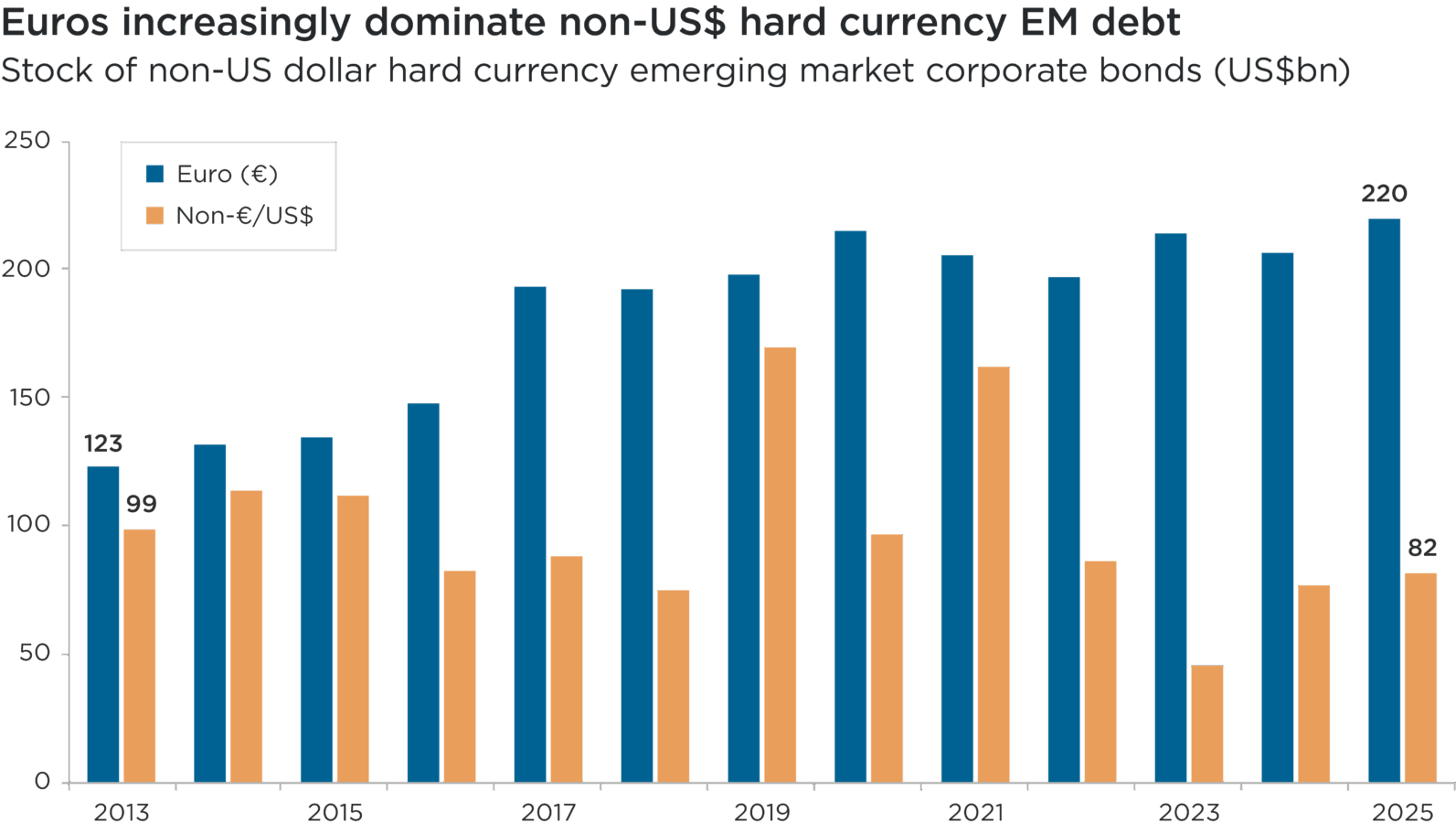
Source: JP Morgan / BondRadar, June 2025. 2025 data as at 31 May 2025.
Subhead: Stock of non-US dollar hard currency emerging market corporate bonds (US$)
Overview: This bar chart compares the value of emerging market (EM) corporate debt denominated in euros with that denominated in other hard currencies other than the US dollar, for the period 2013 to 2025. It also shows the breakdown of euro-denominated EM credit stock by region of issuer.
Overall, this chart illustrates how euro-denominated EM credit stock has almost doubled over this period, while the value of stock issued in other hard currencies (other than the US dollar) has declined.
Identifying value within euro EM credit
De-dollarisation is being manifested in an acceleration of euro-denominated issuance by EM companies. Euro credit issuance in the Asia-Pacific region exceeded €49bn in the first half of 2025, surpassing the total for 2024.5
In parallel, sovereign EM issuers are also diversifying away from US dollars: Saudi Arabia and the UAE emirate of Sharjah are among governments to have issued in euros this year.6 This helps reinforce the gradual rotation towards euro-denominated EM debt which, in the longer term, will support opportunities for investors focused on the sub-asset class.
In the immediate term, market dynamics mean that investors in euro-denominated EM corporate bonds benefit from slightly higher yields, on average, than those on offer from their US dollar-denominated counterparts. On a cross-currency adjusted basis, it is estimated that dollar-based investors could pick up an additional 10 to 20 basis points, on average, by switching to equivalent euro EM corporate bonds.7 For euro-hedged investors, the appeal is further amplified by recent rises in dollar-euro hedging costs.
Bottom-up credit selection can also unlock further spread differentials. For example, we observed that euro-denominated issuances by a Mexican energy company and a Hong Kong-listed Chinese conglomerate offered yield pick-ups of 55 and 145 basis points in July, respectively, after adjusting for hedging costs.8
Significant divergence in yield spreads between individual issuances means selectivity remains key for those focused on this part of the market.
An expanding opportunity set
More than 95% of international investors in EM credit still primarily hold US dollar-denominated bonds.9 This largely reflects the fact that the most prominent index, the JP Morgan Corporate Emerging Market Bond Index, only includes US dollar-denominated debt.
Should de-dollarisation continue, we would expect a virtuous and mutually reinforcing cycle of rising euro-denominated issuance and the sustained expansion of the investable euro EM credit universe.
This trend will enable active credit investors whose mandates enable them to include non-dollar bonds in portfolios to better diversify their hard currency risk – while also capturing any potential spread advantages along the way.
1 Bank of International Settlements, September 2024: The US dollar and capital flows to EMEs
2 Goldman Sachs, April 2025
3 JP Morgan, June 2025
4 JP Morgan, June 2025
5 Flynn, F., 23 July 2025: Asian Local-Currency Bond Sales Reach Record on Risks to Dollar. Bloomberg
6 George, L. & Maccioni, F., 2 July 2025: Emerging market debt sale surge defies global turmoil amid signs of de-dollarisation. Reuters
7 JP Morgan, July 2025
8 JP Morgan, July 2025. Data as at 21 July 2025
9 JP Morgan, May 2025
References to specific securities are for illustrative purposes only and should not be considered as a recommendation to buy or sell. Nothing presented herein is intended to constitute investment advice and no investment decision should be made solely based on this information. Nothing presented should be construed as a recommendation to purchase or sell a particular type of security or follow any investment technique or strategy. Information presented herein reflects Impax Asset Management’s views at a particular time. Such views are subject to change at any point and Impax Asset Management shall not be obligated to provide any notice. Any forward-looking statements or forecasts are based on assumptions and actual results are expected to vary. While Impax Asset Management has used reasonable efforts to obtain information from reliable sources, we make no representations or warranties as to the accuracy, reliability or completeness of third-party information presented herein. No guarantee of investment performance is being provided and no inference to the contrary should be made.