
 United States
Employee sentiment is a valuable but overlooked aspect of corporate culture. Intuitively, the attitudes of workers should be a key determinant of company success, yet corporate culture metrics – while important – do not fully capture the nuance and immediacy of employee perceptions.
A wealth of unstructured data exists in the form of textual reviews, by workers and ex-workers, on open-source platforms like Glassdoor and Indeed. By developing a robust process for analysing this data, we have identified powerful correlations between employee sentiment scores and stock performance. These relationships differ between regions and company size.
We believe that our proprietary, three-year rolling employee sentiment score can demonstrably provide a valuable forward-looking signal of shareholder returns and contribute as one input into the broader Impax Corporate Culture Indicator framework.
The importance of employee sentiment
Investors’ interest in corporate culture as an intangible asset has undoubtedly been on an upward trajectory. Metrics like diversity ratios, employee turnover and pay equity are well established and can offer valuable insights into a company. However, these company-reported metrics cannot paint a complete picture of cultural conditions.
Accurately assessing corporate culture fundamentally requires insights from those most familiar with the organisation: its employees. While companies may disclose high-level results from employee satisfaction surveys, such formal disclosures lack the nuanced perspective of time-stamped accounts that come directly from employees.
Crucially, employee sentiment should logically be a leading indicator of corporate cultural health. Engaged workers who feel motivated and rewarded should, in theory, be more productive and contribute towards more positive company outcomes. Conversely, today’s grievances – especially where they relate to key aspects of employee sentiment – might reasonably be expected to manifest themselves in future company underperformance.
Quantifying employee sentiment
Our proprietary employee sentiment score leverages two of the most comprehensive sources of direct employee feedback: Glassdoor, a website for workers and ex-workers to anonymously review their employers, and Indeed, an online job platform that includes employee reviews.
To ensure completeness and account for platform preferences, we aggregated roughly 55mn reviews posted on both sources – including both numerical ratings and unstructured text reviews – going back to 2007. Text-based feedback provides more qualitatively rich and nuanced information than numerical ratings, enabling more insightful analysis.
A key input to effective textual analysis is the choice of key words. Having alighted on nine key dimensions of corporate culture – including ‘collaboration’, ‘customer focus’ and ‘integrity’ – we used semantic filtering to isolate reviews related to these aspects of corporate culture.
By ascribing values to varying intensities of positive and negative reviews, based on analysis of key words, we have constructed a rolling score that quantifies sentiment for more than 2,000 companies globally. We limited our analysis to the 2015 to 2025 period, given employee reviews have become more frequent over time.
We have taken a rolling three-year measurement window because meaningful cultural transformation within organisations is a gradual process. This is supported by research finding that sustainable cultural change initiatives often take two to three years to yield measurable behavioural and cultural shifts across a workforce.1
Finally, we also only include companies that have a statistically valid number of reviews and take steps to address concerns relating to data validity. For instance, a common criticism of these platforms is that employee reviews may be doctored or fake. We look to mitigate this risk by filtering out data points where the text is unusually brief. Glassdoor itself tackles this issue by restricting multiple reviews from the same user and prohibiting bot activity on its platform.
Ex-employee reviews naturally have a negative skew. However, this should logically be consistent across all companies and, given our analysis of sentiment is relative not absolute, so do not skew the usefulness of the data.
Isolating correlations with company performance
Overall, our employee sentiment score has a demonstrably positive correlation with forward-looking stock performance. In some cases, we have identified clear historic patterns that indicate the value of employee sentiment as a leading indicator of stock returns.
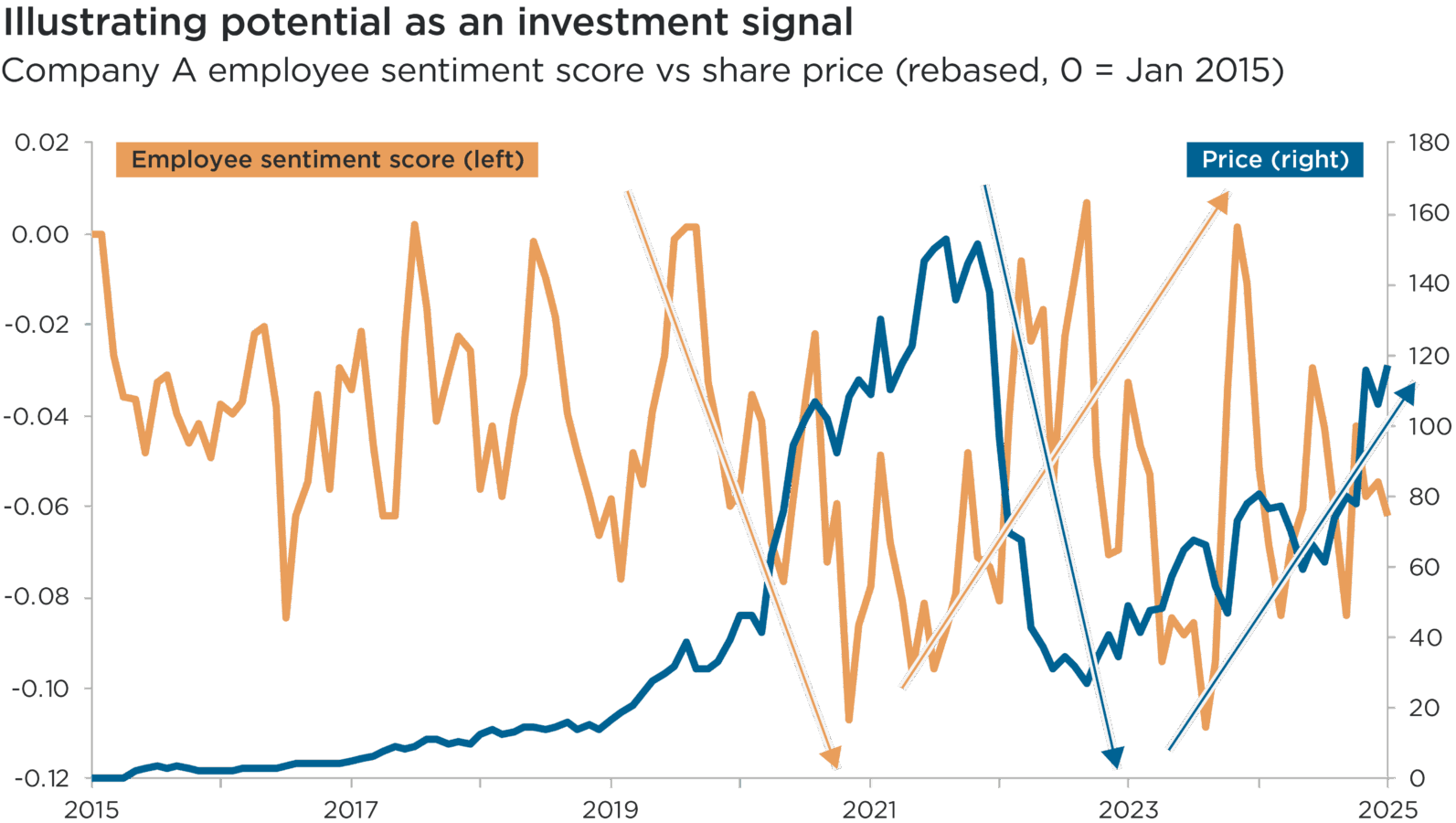
The chart below compares the employee sentiment score and share price of a North American ecommerce platform over the past decade. As illustrated, the company’s share price fall in 2022 followed a decline in worker sentiment two-to-three years earlier. Likewise, its recovery mirrored an improvement in sentiment thereafter.
Past performance is not indicative of future returns.
Source: Impax analysis, 2025. Period from 31 January 2015 to 31 January 2025.
Subhead: Company A employee sentiment score vs share price (rebased, 0 = Jan 2015)
Overview: This line chart compares the employee sentiment score of Company A (a North American ecommerce platform) and its share price between January 2015 and January 2025. The employee sentiment score is represented by the orange line (and left-hand y-axis) and the share price by the blue line (and right-hand y-axis).
Overall, this chart illustrates the relationship between Company A’s employee sentiment score and share price during the period. The arrows highlight how a share price fall in 2022 followed a decline in worker sentiment two-to-three years earlier. Likewise, its recovery mirrored an improvement in sentiment thereafter.
Macroeconomic and company-specific factors are, of course, also at play. However, in our view, the correlations are too material to dismiss – especially in certain regions and among certain types of companies. Three trends stand out.
First, we observe particularly significant and consistent relationships with stock performance in North America and emerging markets.
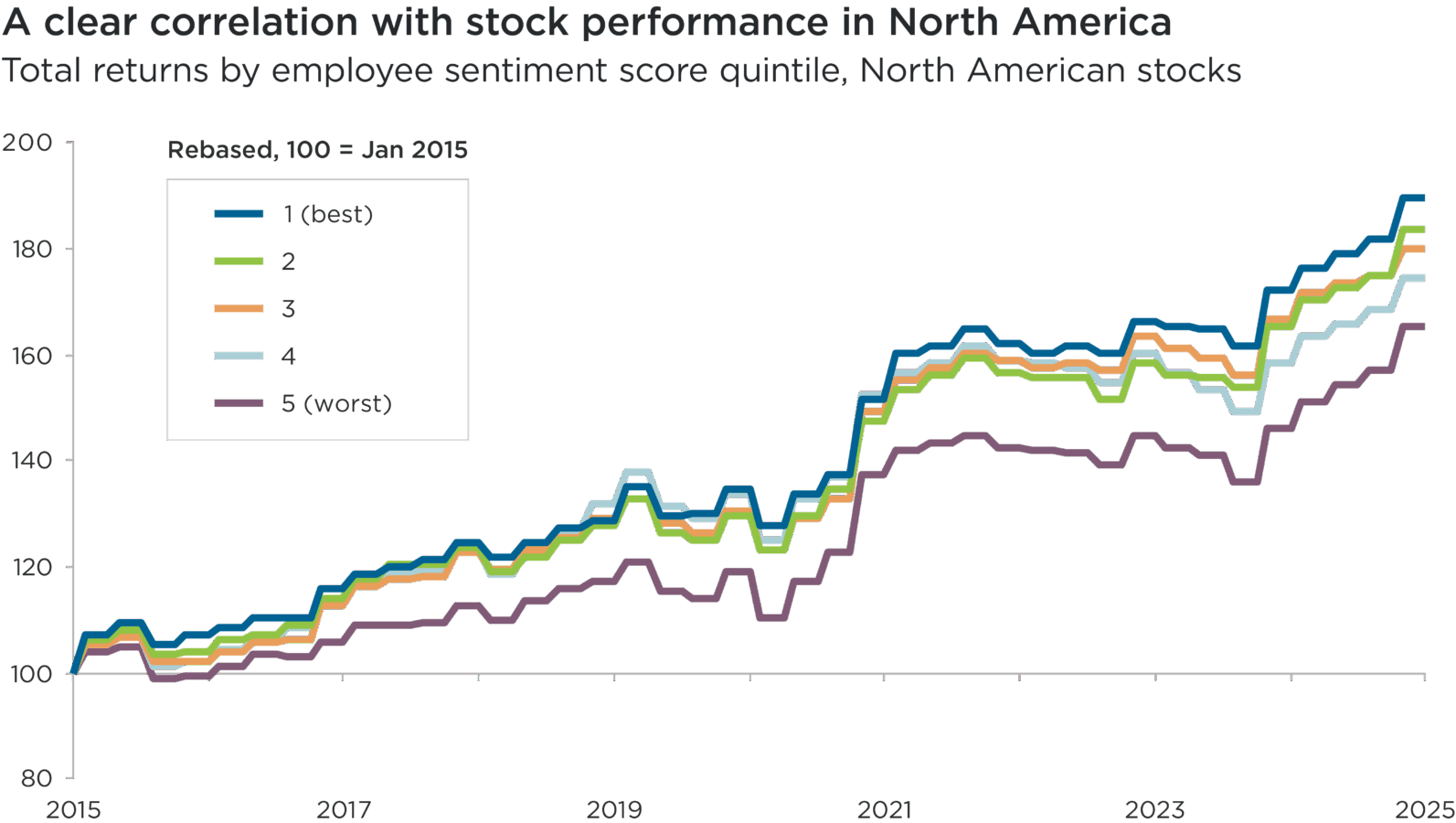
In North America, the lowest-scoring companies (the fifth quintile) in our universe delivered substantially weaker returns than all other groups. As shown in the chart below, the performance gap between these laggards on employee sentiment and their peers was both statistically significant and economically meaningful throughout the past decade. The highest-scoring companies (first quartile) also delivered the strongest total stock returns.
Past performance is not indicative of future returns.
Source: Impax analysis, 2025. Period from 31 January 2015 to 31 January 2025.
Subhead: Total returns by employee sentiment score quintile, North American stocks
Overview: This line chart compares the aggregated total returns of North American stocks, between January 2015 and January 2025, according to their employee sentiment score, as ranked by quintile.
Overall, this chart illustrates that, overall, North American stocks with top quintile employee sentiment scores delivered the highest total shareholder returns during this period. Conversely, those with the lowest quintile employee sentiment scores delivered the lowest total shareholder returns.
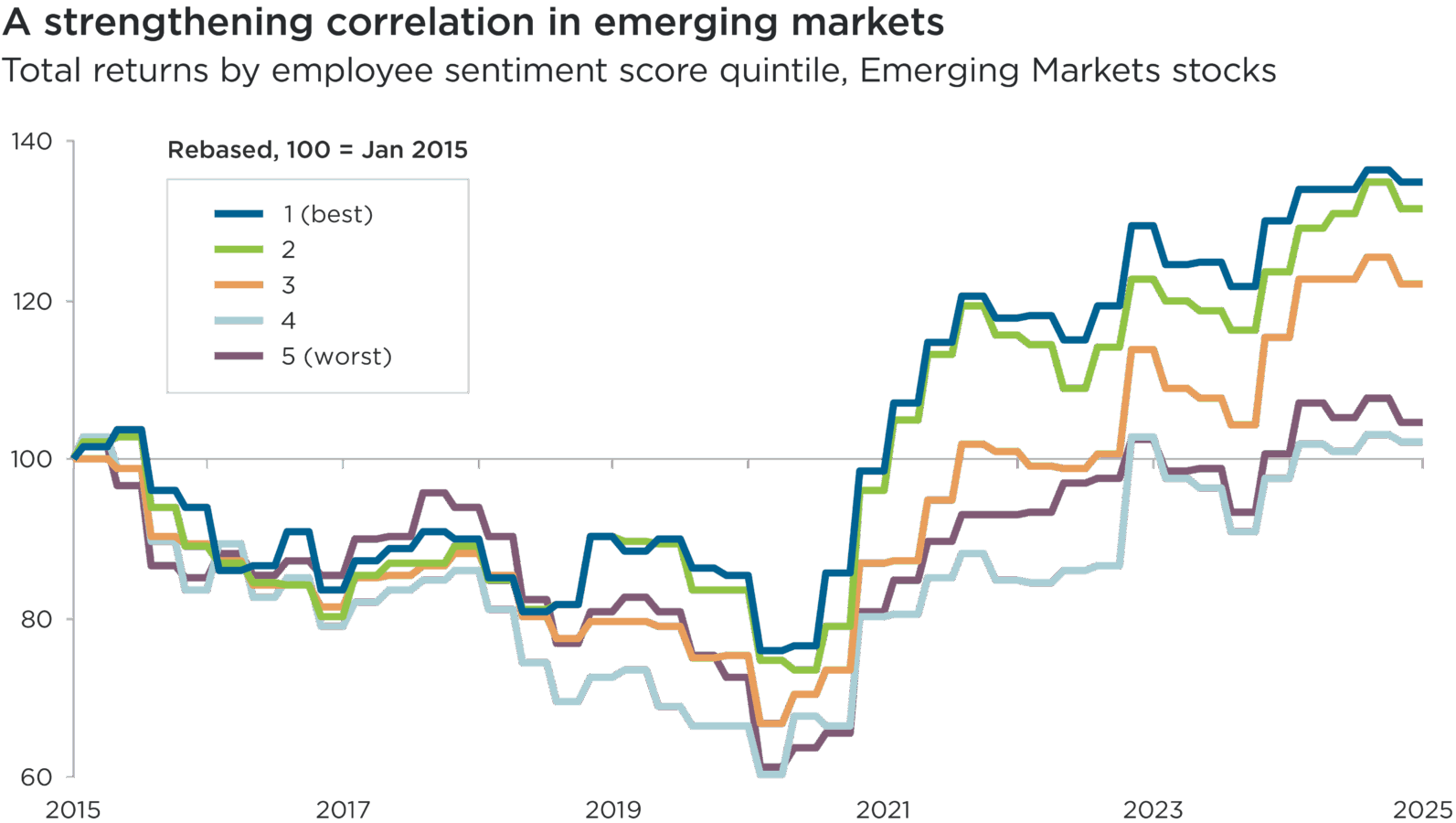
A statistically significant correlation was also found in emerging markets (see chart below), strengthening over the period.
We hypothesise that corporate culture serves as a key differentiator among North American and emerging market companies, which more commonly operate in environments with weaker mandated workers’ rights. Employee wellbeing is therefore likely to be more variable and more dependent on individual employer policies than in Europe, for example. We believe that in Europe – where no definitive conclusions could be drawn from our analysis – well established corporate and regulatory standards may diminish the influence of employee reviews on performance.
Past performance is not indicative of future returns.
Source: Impax analysis, 2025. Period from 31 January 2015 to 31 January 2025.
Subhead: Total returns by employee sentiment score quintile, Emerging Markets stocks
Overview: This line chart compares the aggregated total returns of Emerging Markets stocks, between January 2015 and January 2025, according to their employee sentiment score, as ranked by quintile.
Overall, this chart illustrates that, overall, Emerging Markets stocks with first and second quintile employee sentiment scores delivered the highest total shareholder returns during this period. Conversely, those with fourth and fifth quintile employee sentiment scores delivered the lowest total shareholder returns.
Second, the relationship between the employee sentiment score and stock performance significantly strengthened during and after the COVID-19 pandemic.
The charts above, for both the North American and emerging market regions, both illustrate the more pronounced divergence between top and bottom quintile performance since early 2020. This suggests that companies that successfully adapted, remained flexible and innovated during this period saw improved returns.
The pandemic accelerated trends towards automation, crisis resilience and hybrid work models. This was also a period when employees in many sectors had increased power to move between organisations, so culture likely played a role in retaining key talent.
Third, the relationship between the employee sentiment score and stock performance is found to be stronger among large-cap companies than for mid- or small-cap stocks. This could be due to two factors: more consistent data availability; and larger budgets that allow resources to be allocated to initiatives designed to structurally benefit employees and corporate culture (and go far beyond minimum required local standards).
Clearer correlations are also found among some sectors than others. In North America, for example, Consumer Discretionary stocks exhibited a strong relationship, overall, where as Financials did not. Further investigation of the extent to which corporate culture drives performance by sector is warranted, however.
Employing these insights in the Corporate Culture Indicator
Employee sentiment data offers an added dimension of human capital management and quality that seems to provide important insights.
The significant correlations identified support our conviction that this method serves as an innovative way to assess and quantify corporate culture from an employee perspective. Not only have these traditionally been hard to quantify, but they crucially serve as timely information on companies’ on-the-ground operations that tend to lead – not lag – company results.
This promising signal of company performance is now included within the latest iteration of the Impax Corporate Culture Indicator framework, alongside a range of factors including employee turnover and workplace equity policies.
The Corporate Culture Indicator – which is a cumulative score based on these culture-related metrics – is currently used as an input for two Impax investment strategies.2 While investment decisions are not taken based on the Corporate Culture Indicator in isolation, we do see it as a highly promising tool for risk management and for identifying potential alpha.
Our Corporate Culture Indicator framework is a constant work in progress and will continue to evolve as we explore and refine the efficacy of individual signals. The addition of this proprietary model for capturing employee sentiment further enhances our approach to evaluating companies’ management of human capital and quantifying its potential impact on long-term performance.
1 The Conference Board, 2023: Building a Sustainability Culture
2 Impax Global Social Leaders and Global Women’s Leadership strategies
This content is provided solely for educational and illustrative purposes. The graphics provided throughout this material are intended to show the effectiveness of our proprietary employee sentiment score, which forms one component of the Impax Corporate Culture Indicator, when used as a screening tool to evaluate the performance potential of securities based on their culture scores. There is no guarantee that these trends will continue and these scores are a single consideration in our investment process for certain strategies. These graphics do not represent performance of any product or managed account strategy. No representation is being made that any account will or is likely to achieve results similar to those shown. Further information is available on request.
Nothing presented herein is intended to constitute investment advice and no investment decision should be made solely based on this information. Nothing presented should be construed as a recommendation to purchase or sell a particular type of security or follow any investment technique or strategy. Information presented herein reflects Impax Asset Management’s views at a particular time. Such views are subject to change at any point and Impax Asset Management shall not be obligated to provide any notice. Any forward-looking statements or forecasts are based on assumptions and actual results are expected to vary. While Impax Asset Management has used reasonable efforts to obtain information from reliable sources, we make no representations or warranties as to the accuracy, reliability or completeness of third-party information presented herein. No guarantee of investment performance is being provided and no inference to the contrary should be made.